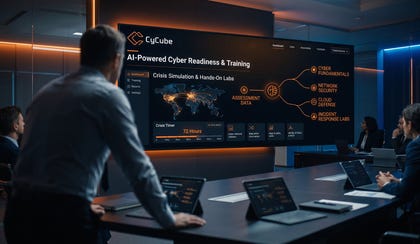
Etti Berger, founder and CEO of TripleP, discusses the illusion of readiness and explains how the CyCube training platform seeks to bridge the gap between theoretical knowledge and operational competence.
The global cybersecurity industry generates hundreds of billions of dollars annually, and large and medium-sized organizations invest huge sums in acquiring advanced defense systems, monitoring platforms and automated analytics engines. On paper, through the eyes of the SOC, the organization appears protected. However, in the moment of truth, when hackers identify and exploit a vulnerability, defense systems can miss threats or overwhelm teams with alerts. It turns out that even employees who have undergone training and certification do not always succeed in applying their accumulated knowledge, identifying threats and functioning effectively.
"There is a severe illusion of monitoring and protection in the market," says Etti Berger, owner and CEO of TripleP – which developed an advanced training platform in cybersecurity and AI. Berger identifies the industry's central failure not in a lack of technological tools, but in the absence of practical skills and operational competence among the employees and managers who are supposed to operate them in real time.
"It starts with managers sending employees to prestigious 80-hour courses. Employees return with promising certifications, and managers are quick to tick a box and are convinced the team is fully competent," Berger adds. "However, this is a wrong and dangerous perception, as there is a dramatic gap between theoretical knowledge and practical execution. It's like high jumping: people are confident they know how to jump, but forget that before the leap and jump, they must know how to run correctly. If you don't practice the run and the practical steps in a real environment – you will crash into the bar."

Highlighting Skill Gaps
Berger, who has been involved in cybersecurity and information security for three decades – both in senior management and development roles and as an independent professional – founded TripleP in 2018 to realize a new pedagogical-technological concept in cybersecurity. This vision materialized into the company's CyCube training platform: an AI-based engine that does not settle for standard instruction and training, but rather assesses team skills in real time, diagnoses strengths and weaknesses, and provides personalized, adaptive training paths based on practical exercises in closed, controlled environments that simulate real-world incidents.
"The ultimate goal is to expose the real skill gaps to management and Chief Information Security Officers (CISOs)," Berger explains. "We are familiar with the classic 'Gaussian bell curve' distribution in organizations – there are a few excellent individuals, a weak group, and an overwhelming majority in the middle. In cybersecurity, such a distribution makes it difficult for an organization to ensure uniform competence. Our goal is to reduce these gaps and raise the competence level of the entire team. The system provides a personalized and focused response to each employee's weaknesses, with continuous measurement and monitoring, bringing the entire team to a high level of operational competence."
The system operates on a continuous learning model. It does not settle for a one-time test asking whether the learner 'remembers' educational material in forensics, operating systems or encryption, but rather measures in real time how they practically apply the material and respond to operational challenges. The anonymous and statistical data collected continuously feeds and updates the system, making scenarios more dynamic and complex in line with evolving market threats.
Addressing New-Generation Threats
As in many other fields, the development of generative artificial intelligence and large language models (LLMs) has created a new reality in cybersecurity. While threats previously focused mainly on classic organizational IT environments, today the front has expanded to critical operational technologies (OT) – energy, water, health and transportation systems – where a cyberattack does not merely result in financial damage or data leakage, but poses a real danger to human lives.
According to Berger, organizations' blind reliance on automated AI solutions for defense, especially in the critical infrastructure sector, is another dangerous illusion. "AI systems are not immune to errors. They can be influenced by biases and manipulations, identify a legitimate event as a threat or miss a real threat. When automated systems operate based on incorrect identification, the consequences for the organization can be severe. In hospital operational systems, however, such a failure no longer amounts to a loss of efficiency – it can cost human lives."
Furthermore, attackers themselves are now leveraging autonomous AI agents to carry out sophisticated attacks at unprecedented speeds and scales. Conversely, even within organizations, AI agents and automated systems can exceed their original permissions or be exploited for malicious purposes. Against this backdrop, the need for skilled human oversight becomes more critical than ever. Humans and AI must work hand-in-hand, with humans understanding the model's limitations, identifying anomalies in real time, and knowing how to intervene and stop an incident.
To address threats arising from the new generation – from the misuse of large language models (LLMs) to generate sophisticated social engineering attacks to breaching organizational AI systems – TripleP's CyCube training platform includes dedicated in-depth exercises, pitting teams against complex hybrid attack scenarios in controlled environments.
Insurance Potential and Human Capital
TripleP's offering is not limited to refining human capital skills within an organization, but also directly impacts its business and management processes. The platform, delivered in a SaaS model on the AWS cloud, does not require software installations, hardware or physical labs, and is easy and convenient to operate – with users able to purchase the entire system or acquire usage licenses. Thus, alongside strengthening teams' practical skills in the moment of truth, the organization benefits from operational flexibility and a measurable business value proposition.
The platform is designed for and suitable to a wide range of entities in the business and public sectors (the company operates in B2B and B2G models) – from large organizations to Managed Security Service Providers (MSSPs), centers of excellence and cybersecurity academies. Additionally, the company targets educational and higher education institutions (for example, computer science departments in academia), aiming to integrate the dimension of practical training alongside theoretical studies.
Berger also sees potential for the platform to change the field of cybersecurity insurance. Instead of relying primarily on questionnaires, she believes that insurance companies can use a competence index based on the actual performance of an organization's teams. If such an index is adopted, it could help in risk assessment and premium determination according to the level of readiness. Berger also hopes that in the future, the platform could be connected to human resources systems, so that proven improvement in employee skills could serve as a basis for incentives and rewards.
"Organizations can continue to invest millions in advanced security solutions, but they must also know how their teams will perform in the moment of truth," Berger concludes. "Our goal is to reduce the gap between the feeling of readiness and actual operational capability, through continuous training and measurement."
Partnered with TripleP