A foot wound might sound like a localized problem, but for a person living with diabetes, it can become a life-changing event. A diabetic foot ulcer (DFU) can remain open for a long time, leading to infections and hospitalizations, and in severe cases, even amputation. The numbers illustrate the scale of the challenge: estimates suggest that between 19% and 34% of people with diabetes will develop a foot wound during their lifetime, and about 20% of patients who develop such a wound will undergo lower limb amputation. Even after healing, the story does not necessarily end: about 40% of wounds recur within a year.
One of the main challenges in treatment is that with every step, pressure is reapplied to the area being treated. Therefore, one of the treatment principles is offloading – reducing pressure from the wound. However, while the wound changes throughout the healing process, many solutions remain static and require the patient to visit the clinic many times for readjustment – which burdens the healthcare system and is often simply not feasible at the required frequency.
Beyond the human cost, diabetic foot ulcers are also among the most expensive complications of diabetes. In the U.S. alone, the additional cost of treating them was estimated at about $9-13 billion per year, due to repeat visits, hospitalizations, infections, amputations and rehabilitation. This means that improving healing rates and reducing hospitalizations and amputations are not only a medical goal but also a significant economic interest for healthcare systems.

The story of GD STRIDE began when Gidon Weinberger, an engineer and product manager, approached Daniel Weisz, a podiatrist with 30 years of experience and president of the International Federation of Podiatrists, with an initial idea.
After long discussions and meetings with patients at Daniel's clinic, a question arose that became the foundation of GD STRIDE: If the wound changes – why shouldn't the insole change with it, and not just during a clinic visit?
"We saw that there was no shortage of monitoring tools, but there was a gap between the information collected and the ability to implement it quickly – before the wound condition worsened again," says Weisz. "We realized that to close this gap, the insole needed to be transformed from a static tool into a dynamic therapeutic tool – one that changes with the wound and adapts throughout the healing process."
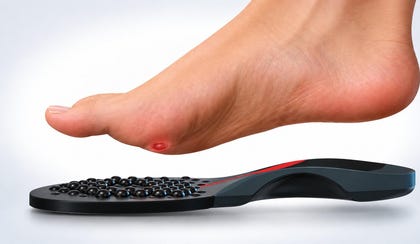
The solution developed by GD STRIDE combines a scanning system, an insole with remotely adjustable areas, and a digital platform connecting the patient to the care team. After scanning the foot, the therapist can remotely adjust the insole's structure and create targeted offloading according to the wound's location and clinical needs. Frequent scans and the ability to make adjustments throughout the treatment allow for closer monitoring and adaptation of the offloading to the wound's changing condition.
Three Years, Six People and One War
Behind the technology is a small, cohesive Jerusalem-based team of six people, who share a sense of mission and a common goal. The team managed to complete the system's core development in just three years – a period that also coincided with one of Israel's most complex times. Most of the company's employees are active reservists, and work continued between periods of reserve duty, uncertainty and disruptions to routine. The reality of the war period naturally entered the company's life as well. One team member, a young ultra-Orthodox man who joined without a military service background, decided during this period to enlist in the IDF, partly due to his connection with his team members who served in the reserves.
Despite this, the company completed significant milestones. In a clinical trial conducted in the Czech Republic, the system was tested on 20 patients with diabetic foot ulcers. Within 48 hours of starting treatment, healthy tissue growth was observed in 73% of patients. For the company, the trial provided a clinical indication of the system's ability to support the healing process in real-world conditions. Concurrently, the system was registered with the FDA and the company received a patent in the U.S., alongside continued expansion of intellectual property protection in additional markets.
Now, after proving clinical feasibility, GD STRIDE is moving to the next stage: expanding manufacturing capabilities and preparing for entry into international markets.
Every use of the system also has an additional layer: throughout the treatment, information is collected on the wound, adjustments, and the healing process. GD STRIDE uses the accumulated data and AI to learn from previous treatments, assist in more precise adaptation of the next treatment, and identify patterns that will help prevent the formation of new wounds.
Replacing Despair with Hope
When asked what motivates the people at GD STRIDE, they turn to the patients. For a person struggling with a non-healing diabetic wound, the path can become a long journey of treatments, limitations, fear of worsening, and sometimes real fear of amputation and disability. This is the feeling of helplessness that the team seeks to change.
"Our guiding goal is to give patients a better chance to heal, to walk again, and to return to their daily lives," says Weinberger. "That's why we develop solutions that work in the real world, not just in laboratory conditions – ones that fit the patient's life, and don't require them to adapt their life to the treatment." For the company, the meaning of remote treatment is not to replace the doctor, but quite the opposite – to allow them to remain part of the treatment even between visits.
The Vision Doesn't Stop at Diabetic Foot Care
The ability to dynamically change support and load distribution under the foot is relevant to other conditions where the way we stand and walk has therapeutic significance. GD STRIDE is already working on expanding the platform to the fields of rehabilitation, posture problems, and sports injuries. The idea remains the same: instead of setting a solution at a single point in time, to create a system that learns, changes, and adapts treatment along the way.
From diabetic wound treatment to rehabilitation and sports, GD STRIDE returns to the same vision: to connect innovation, technology, and personalized treatment – to improve patients' lives, enable them to heal, regain movement, and live better.
For more info: gdstride.ai
Partnered with GD STRIDE