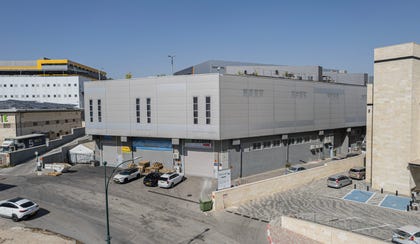
Only three years after the establishment of the State of Israel, in 1951, Urdan Metal Industries and Steel Castings Ltd. began its operation as a foundry. Since then, and over decades of activity, Urdan has developed unique capabilities that place its products in the top tier worldwide with respect to the quality and reliability of the casting, making it a leading manufacturer of steel in the local and international military and civilian market.
Sand casting technology
"The Urdan foundry went through several transformations. In the early 1970s, the State of Israel decided to establish its own tank industry," says Yaron Davidi, who has served as CEO of the company for the last 14 years. Three companies were set up to be strategic manufactures for the APC industry in Israel One of them was the Urdan foundry, which was designated to produce the castings for the future tanks of the IDF. Today, Urdan is the exclusive supplier of the truck shoes for the Merkava and Namer tanks, and qualified to supply all the other castings. It produces castings weighing between a few kilograms up to 12 tons and more."

"The core of Urdan's activity is the foundry, which produces mainly steel castings for the production and maintenance of tanks and APCs. Urdan's military customers include the Israel Ministry of Defense, Elbit, Ashot, Israel Aerospace Industries, Israel Military Industries, Rafael, BAE, KMW, and GDLS, as well as the defense ministries of the US, Finland, Canada, and others. Urdan also manufactures products for the civilian sector, including castings for the maintenance of process plants (for example, the Israel Electric Company, the ICL group, quarries, and cement plants), as well as parts for assemblies of mining tools, sailing vessels, hulls, and more.
The Urdan foundry is capable of producing about two hundred types of steel (forgings), and is considered one of the highest-quality steel factories in the world for military purposes. Davidi explains that they use sand casting technology, with the molds made of hardened sand. "Among others, the Urdan foundry manufactures caterpillar links for all types of tanks, castings for the truck shoes of the Merkava tank, and parts of the tank and turret such as the turret cradle, which weighs more than two tons. The variety of castings produced in the factory includes carbon steels, alloyed steels, high-strength steels, stainless steels, manganese steels, armor steels, abrasion- and corrosion-resistant steels, high temperature resistant steels, nickel fuses, Ni-resist spheroidal castings, and iron castings. All products comply with the ISO 9001:2008 standard.
Production of a variety of systems for armored vehicles
As part of its range of services, Urdan advises customers about the appropriate type of steel based on the mechanical requirements of their various products. Urdan produces castings according to either specifications (BTS) or drawings (BTP), depending on customer requirements. For example, products for ballistic protection require a different composition than those for truck shoes . The product engineering department includes model planning, testing and simulation tools, as well as an experienced professional metallurgical support system.
Urdan services are backed by professional and skilled human capital. The company employs about 150 people at its factory in Netanya. Employees work in engineering and planning, production, maintenance, logistics and service, quality assurance, administration, and marketing. Since 1985, Urdan has been operating another facility at Mitzpe Ramon, Urdan Mitzpe Ramon, managed by Meital Sasson, a local engineer. The factory in Mitzpe Ramon manufactures armor frames and kits for the Merkava, Namer, and Eitan projects.
How is the steel smelting carried out at Urdan and what are the quality control processes for the molten material?
"Steel is smelted in arc furnaces that allow the steel to be refined to the highest level of cleanliness – a necessary condition for high-quality steel. This smelting method, unique procedures and knowledge about the thermal treatment of the products, and advanced processing methods guarantee the quality and durability of the casting over time and under difficult conditions. In the metallurgical laboratory, the chemical composition of the molten material is tested using a spectrometer. In addition, we have a sand laboratory for testing the raw material for patterns, a laboratory for testing mechanical properties, various means of non-destructive testing (NDT), and modern equipment for geometric tests. About 8% of our employees are quality professionals. Urdan operates in accordance with the strictest local and international standards."
In addition to steel casting, what other products are manufactured at Urdan for the defense industries?
"We develop and manufacture additional systems for armored vehicles, such as mine clearing roller systems (MCRS), a mechanism of wheels mounted on the front of the armored vehicle used to detonate mines and explosive devices to prevent damage to the vehicle and allow it to maneuver despite the threat of mines. Another system is the dozer attachment, known in the IDF as the “Urdan attachment.” This is a system attached to a tank or other APC that allows it to function as a bulldozer for clearing obstacles, building positions, and similar tasks.”
“Another of our one-of-a-kind systems is a versatile towing vehicle for APCs (backtrail). This is a platform for carrying logistics cargo by any type of heavy APC. The trailer can be towed by a tank or a heavy APC and can carry up to 8 tons. The load can be any cargo, from water, fuel, and ammunition to maintenance equipment and intelligence or cyber devices. The main advantage of the system is that it increases the duration of maneuvering in combat areas, reducing the exposure of supply lines to threats, and separating explosive material from the combat team (in the case of ammunition). Moreover, the towing places almost no limitation on the maneuverability of the APC."
Are these systems also marketed to other armies?
"All the systems are in use by the IDF, and the versatile towing system for APCs was developed and manufactured by Urdan with the encouragement of the IDF, following the lessons learned from the Second Lebanon War. Dozens have been sold to the IDF to date. A foreign MCRS system manufactured by Urdan is also in use by armies in the USA, Canada, and Finland, and other armies are showing interest in the dozer attachment. All of Urdan's military systems and products have passed all the tests of both the IDF and foreign armies, and most of them have proven themselves in battle. Urdan also plans to make adjustments to connect its systems to all types of APCs.
In cooperation with Urdan Ltd.