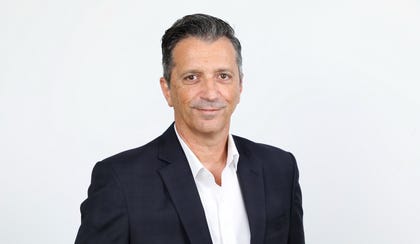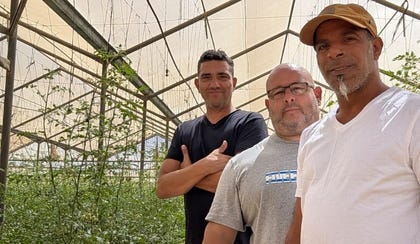
Dr. Tzilhav Shem-Ad, UVIVEA's CEO, holds a doctorate in molecular biology, completed a postdoctoral fellowship in neurophysiology, and holds an MBA in health innovation and entrepreneurship. During the Covid-19 pandemic, he took part in leading the national deployment of automated viral diagnostics in Israel's health funds. There he gained an important insight: early and rapid detection changes the entire picture.
Guy Dahari, the company's COO, has two decades of experience in agricultural operations management, infrastructure and technological environments. He previously served as director of operations at Canndoc, one of Israel's leading medical cannabis producers. In his work, he was exposed to light treatments using the Far-UVC method, which suppresses the development of plant diseases.
The insights the two gained, each in their own work, allowed them to combine their knowledge and establish UVIVEA, with the support of serial entrepreneur Adi Gelvan, a member of the advisory board. The goal: to identify plant diseases as early as possible and save the crop in time, a rescue that means significant financial savings for the grower.
"Plant diseases and invasive insect pests together cost the world more than $290 billion a year," says Dr. Shem-Ad. "Growers worldwide spend $19 billion a year on fungicides alone, and a single gray mold event can wipe out up to a quarter of the annual crop. But the greenhouse grower contends not with one disease but with five simultaneous pressures.
Chemistry is losing its power: in vegetable greenhouses in Crete, 42% of gray mold isolates are resistant to four active ingredients at once. Biological pest control, on which 57% of Almeria's greenhouses in Spain already rely, solves the pest problem, but not the fungi. Retail chains are stricter than the law requires and keep lowering the residue ceiling on fruit. Greenhouse work is labor-intensive, and there are not enough skilled hands to scan and detect disease in time. And the classic tool, climate control, is expensive: it can account for up to a quarter of a greenhouse's annual operating budget, and any setting that starves the fungus also slows growth and burns gas."
"Yes, and they fall into two categories. The first are alert systems: sensing systems that usually detect a problem only when the symptom is already visible, cannot tell fungus from dryness, and leave it to the grower to decide and act. The grower keeps paying for labor, and sometimes sprays in vain. The second are treatment systems: UV robots that irradiate the entire greenhouse on a schedule, without distinguishing between sick and healthy plants, only at night and with no people inside. Chemical spraying always reacts late, leaves residues and accelerates resistance."
"UVIVEA is developing an autonomous biosecurity operating system for greenhouses, which closes the loop from detection to treatment without human intervention. It is designed to do four things in sequence. Monitor every plant, including the microclimate between the rows, which the climate computer does not sense, and feed that data to it. Predict early signs of disease and distress, such as thirst, lack of fertilizer or heat stress, which make the plant vulnerable, from several layers of light, heat and climate. Forecast where the risk is rising in the greenhouse on a projected health map. And sterilize the pathogen's focus with light, only on the marked plant. Decisions are made in real time, next to the plant, using edge computing. The power lies in timing: detection occurs while the focus is still small, before the eye sees it and before it spreads spores to neighboring plants. According to a 2021 study, the light we use kills mold spores up to 10 times more effectively than conventional 254-nanometer UV-C, without the need for darkness and without harming photosynthesis, pollen germination or fruit set. This means treatment can also be applied during the day, without evacuating the greenhouse or stopping work."
UVIVEA chose to name the system "TITAN Sahar", after the late Saar Margolis, a member of Kibbutz Kissufim's emergency response squad, who went out to defend the kibbutz on the morning of October 7, 2023, and fell in battle. The company won an Israel Innovation Authority grant for proof of concept, filed a patent application for the method and the system, and has already built a functional digital twin that includes the decision engine and the application used by the grower. It is currently setting up a laboratory for experiments.
The Central Arava R&D Center has signed a letter of intent with the company, the company is in contact with Delphy in the Netherlands to explore potential further cooperation towards the Dutch market following the proof of concept, and veteran tomato growers from the Eshkol region have already expressed willingness to test the system.
Dr. Shem-Ad: "We are not inventing physics. The effectiveness of the light and of the sensing methods has already been proven in research. Our innovation is the brain above them: sensor fusion and an arbitration engine we developed, which distinguish between fungus and dryness and translate the decision into a precise dose of light, below the plant's damage threshold. No one has published this. The result: an autonomous loop, from detection to treatment and verification."
"In the commercial version, which will be built in the next phase, a smart pod moves vertically on a mast mounted on a robot that travels between the greenhouse rows. The smart pod is the core of the development. It collects multimodal data, namely reflected light, fluorescence, heat and microclimate, and from these it builds a picture of the plant's physiology. This makes it possible to understand what is happening inside the plant even before visible symptoms appear. It is like a blood test, which detects markers of disease or pre-disease before a person feels anything. This capability allows targeted treatment, both curative and preventive, unlike spraying that arrives late or blanket irradiation of the entire greenhouse on a schedule. The system also classifies the stress: whether its origin is a fungus or another pathogen, or a lack of fertilizer, dryness and so on, meaning biotic or abiotic. Thus the light is activated only when the problem is biological, and in other cases the information is passed to the grower and the climate computer, who know how to address it. At the end of the process, the system returns to the same plant, checks it and determines whether the decision and the treatment led to improvement.
Accordingly, using artificial intelligence and machine learning, it will update the probability of choosing the same protocol again. The information enters a database shared by all greenhouses: conclusions from a system in the Netherlands will improve systems in Israel and everywhere else. The more greenhouses are connected, the smarter the system becomes for all of them, and the harder it is for a competitor to close the gap."
"Mainly for advanced vegetable greenhouses, where every hectare is worth a lot. The first target market is vegetable greenhouses in the Netherlands, Spain, Belgium and Germany, where labor is expensive and scarce and retail chains are strict about residues, and in parallel, growers in Israel. The system is also suitable for smart greenhouses that already work with a climate computer, and for seed companies, where every plant is an experiment. The first driver is savings: the system replaces the scout who walks between the rows, by our model saves about half of the fungicides, and saves crops. Since a single severe gray mold event can cost up to about a quarter of the crop, preventing even one such event can cover the installation cost. The second driver is revenue: higher-quality fruit with fewer residues can be sold at a premium price, raising the value of every unit of area."
"The target market is advanced greenhouses in Europe and Ontario: about 35,000 hectares, which spend about $1.7 billion a year on plant protection and scouts. We will start with vegetable greenhouses in the Netherlands, Spain, Belgium and Germany, a market of $427 million. The model: a one-time installation and an annual subscription, meaning recurring revenue. In parallel with the proof of concept, the company is preparing for a staged seed round to build the prototype."
In cooperation with UVIVEA LTD