The modern battlefield contains many different challenges. The implications of the war between Russia and Ukraine, the Iranian threat hovering in the air, and also the existence of various terrorist organizations and militias in the Middle East, require the security forces in Israel to be at the forefront of innovation in order to provide the optimal operational response when necessary, all the more so in the face of threats that are becoming more and more sophisticated at an accelerated pace.
Added to this is the value of the soldiers' lives, which is at the top of the list of priorities for the IDF and the defense establishment. This requires constant thinking and emphasis on advanced technology that can make all the difference and can reduce the dangers lying in wait for the forces in all sectors.
In this security reality, General Robotics is a major game changer. Its advanced technology is designed to give the soldier a relative advantage with improved operational capabilities whose function is to help him make the most informed decision in the face of all types of threats.

For those who are not familiar with the capabilities of General Robotics, this is a family company founded by Col. (ret.) Udi Gal, former scientific deputy to the head of DDR&D (the Directorate of Defense Research & Development) at the Ministry of Defense. The extensive experience that Gal brings with him, combined with wide-ranging professional knowledge, led him from the very outset of the company to lead the development of advanced technologies intended for multi-purpose military use.
General Robotics recently achieved a defining landmark, after it was acquired last March by the American company Sig Sauer, one of the world's leading arms, ammunition, and optical sights companies. To illustrate, some time ago the company won a US Army tender to replace all existing machine guns with light-weight smart machine guns, including the traditional MAG that came into use sometime in 1958. This is indisputably a historic event, of which General Robotics is indirectly a part.
Detection, tracking, and precise shooting capabilities
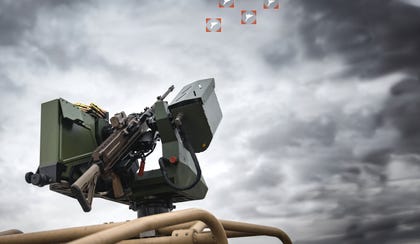
The company’s main specialization lies in the development and production of lightweight and smart remotely-controlled weapons stations (RCWS) that offer improved capabilities based on artificial intelligence, which can be placed on top of armored vehicles. These systems have proven to be effective in achieving a significant improvement in the quality of shooting and firepower, as well as in the manner of spatial orientation and accurate hitting of the target.
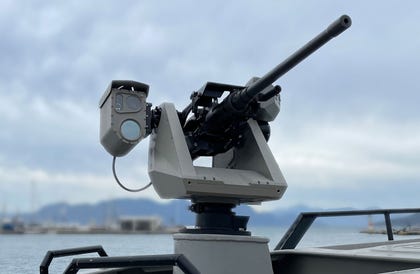
It should be noted that the two most popular General Robotics models, which are widely trusted by foreign armies and security forces in Israel and around the world, are Pitbull, a light and smart terrestrial-controlled weapon station mounted on manned or unmanned vehicles, and Shark, which is the naval equivalent of the Pitbull, adapted for warships, including for small and fast commando boats.
Both systems together present a unique mechanical structure combined with artificial intelligence, which contains an integration of advanced electronics, firmware and software. These refine detection, tracking and accurate shooting capabilities, including against drones, which are considered the most concrete threat in the current security reality. Despite the autonomous capabilities of the systems, which optimize to an unprecedented degree operations, it was decided by General Robotics, based on an informed decision, to leave pressing the trigger to the decision of the human operator, for ethical reasons.
"The Robotic Brain"
General Robotics brings together top-flight engineers in Israel, who specialize in mechanical engineering, electronics, firmware and software. These work in synergy for the development of advanced systems and control units based on automation and full accessibility, as part of the desire to make the job easier for soldiers in the field and reduce the cognitive load, as well as dexterity, skills and training that would have been required otherwise.
The company notes that the military-technological developments they are working on are based on the concept of the "robotic brain," meaning electronic cards with unique firmware and software, used to provide remote situational awareness and operate all types of motors intended for lethal or non-lethal weapons. Moreover, this "brain" works in parallel, paying great attention to the element of safety and incorporating it in the face of the existing operational challenges in the field.
"The idea is to provide a streamlined control system that is adapted to the modern era, one that will enable the soldier to make good decisions in combat conditions, very quickly and efficiently," explains Shahar Gal, CEO of the company and son of the founder, Udi Gal. "While in the past weapon systems were operated by various complex joysticks, requiring the soldier to have capabilities at the level of a fighter pilot, the systems that General Robotics is developing are the complete opposite. They are accessible to every soldier and are activated by touch, where in practice almost all operations are automatic and only require a button to be pressed for confirmation. This is definitely good news on the battlefield, immeasurably improving the capabilities of the soldiers."
Gal goes on to describe the guiding principle of General Robotics, which includes preserving the lives of soldiers as a supreme value. "General Robotics’ specialization in light and smart weapon stations stems from a recognition and an uncompromising desire to protect the lives of soldiers in risk areas. This is the principle that guides us, and we act according to it all the way."
What does this mean in practice?
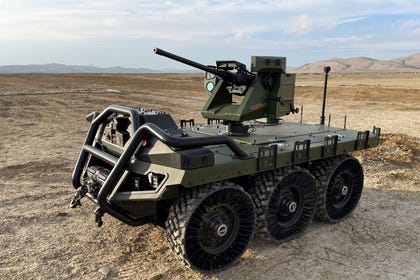
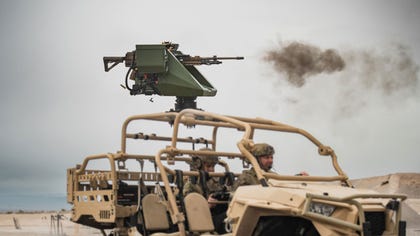
"Today, many soldiers move around in light armored vehicles of varying degrees. However, when they are required to operate the machine gun mounted on the roof of the vehicle, they have to get out of the roof and thus expose themselves to injury. Moreover, when the soldier operates the machine gun in such situations, and especially while moving under fire, his shooting is often ineffective. This is where our systems come into the picture, when the light and smart weapon stations that we developed allow the soldier to operate the machine gun from inside the armored vehicle, significantly improving the possibility of identifying, tracking and hitting the target, day and night. In addition, our weapon stations are also installed on unmanned platforms, thereby moving the soldier even further away from the danger zone."
What are the main threats facing your systems?
"The Iranian 'Shahed 136' unmanned aerial vehicle (UAV), along with advanced drones, are notable threats that require a creative line of thinking from the latest weapons systems, as they have measures to prevent GPS jamming and other interference. Attempts to shoot them down through the use of electronic means may be complex, including laser devices, which as of today are still not practical for use in mobile operational units. The reason for this is that the laser pod weighs hundreds of kilograms, not to mention the fact that the energy required to operate it is equivalent to a heavy container alongside it. In the near future, enemy UAVs will be able to work using image processing technology, so the only mobile solution for shooting them down will be a precision kinetic strike by drone against drone, or alternatively by shooting. This is where the technology of General Robotics comes into play, thanks to a lightweight, smart, and accurate response, with a high percentage of hitting the target."
Minimum energy – maximum efficiency
The unique technology developed as part of the General Robotics weapons systems actually began with a tiny robot designed to fight terrorism inside buildings. In light of its proven results, the company's leaders decided also to develop light and smart weapon stations intended for installation on robotic platforms for outdoor use. Here, too, the results were not long in coming, mainly thanks to unique functions such as identification, tracking, automatic ballistics measurements, and more. "All that is left for the soldier, once the crosshairs are automaticly driven at the target, is simply to press the confirmation button and hit it. His chances of missing it in this case are close to zero," Gal explains.
Indeed, the light weight of the Pitbull and Shark systems, which allows them to be mounted on manned or unmanned vehicles while hardly changing the vehicle's center of gravity, is of the utmost importance, and does not affect the vehicle's damping or braking distance. In addition, General Robotics notes that installing the system is simple and takes just a few minutes, without the need to install electronic boxes inside the vehicle. The system also consumes energy at a minimal output of less than 80 watts per hour, a significant figure that facilitates installation and regular operation on any platform.
Both weapons systems present a unique operating interface based on the Point & Shoot™ method, where the crowning glory – alongside the firmware and software – is, as mentioned, the advanced artificial intelligence capabilities that are part of the automation process. This all helps to characterize and classify the target, in addition to tracking and shooting capabilities that maximize the chances of a hit, including with small and fast targets such as the Iranian ‘Shahed 136’ UAV.
Is artificial intelligence able to change the operational rules of the game?
"There is no doubt that artificial intelligence has led to a tremendous revolution also at the level of defense technologies. Together with the advanced automation processes that we are working on, operations that in the past had to be carried out manually by the soldiers are now done almost without human contact, such as, for example, automatic identification and tracking of drones and other targets by image processing. From the moment the system detects entry of the drone into the space, it homes in on it and at the same time calculates the probability that it will indeed be possible to hit it. It is the automatic algorithm that helps the soldier identify, track and aim, including against extremely fast targets. All calculations from the moment of detection to readiness for accurate firing with the authorization of the operator take place within fractions of a second. The results are amazing and give the soldier a real advantage against the enemy's capabilities, including in extreme weather conditions. This is the place to say that these systems have been successfully connected to radars and fire source detectors, and have demonstrated excellent capabilities against different types of shooting threats, while returning quick and accurate fire."
General Robotics’ weapons systems are currently operational in the IDF and in NATO, and are used by military and security forces in other countries as well, installed on manned and unmanned platforms on land and at sea.
>>> to the company website <<<
In collaboration with General Robotics