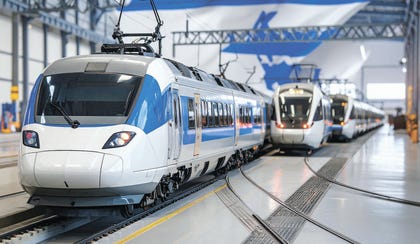
Since the first locomotive rolled out in 1825 — preceded by a man on horseback — railways have transported passengers and freight across intercity routes, light rail systems and through subways. Israel's rail system dates to the late 19th century with the opening of the Jaffa-Jerusalem line. It evolved into Israel Railways following the birth of the State and today, under the Ministry of Transport, is undergoing major expansion with suburban lines, high-speed trains, light rail transit (LRT) and a Metro network for Greater Tel Aviv.
Despite technological advance and substantial investment in infrastructure, however, Israel's railway system faces significant development and maintenance challenges. Matav Rails, launched some eight years ago, seeks to address the technical, operational and academic gaps in Israel's railway sector. Created by a group of entrepreneurs, the company specializes in planning, construction, consulting and engineering of railway systems, with particular expertise in electrification infrastructure and compliance with European standards. It tailors its end-to-end solutions to each client's unique needs in railway system development, design, and maintenance. According to Amir Ziv, company CEO and co-founder: "We truly understand railways."

Matav Rails' founders all have extensive experience in multidisciplinary systems and in regulatory coordination with local authorities and infrastructure providers. The group comprises Ziv, Avi Goldreich, a certified surveyor with decades-long experience in infrastructure detection and surveying, and Rami Shamir, a Technion-trained civil engineer with vast expertise in transport infrastructure in Israel and abroad. He led construction of Tel Aviv's light rail.
They were later joined by Avi Zalman, a railway system veteran with a degree in railway systems engineering from the University of Birmingham and a former deputy CEO for Electrification at Israel Railways. Pioneer of several maintenance methods used across the industry, he is Matav Rails joint CEO.Ziv Levy, vice president of Projects is another key figure in the company's leadership team. An electrical engineer by training, he is expert in high- and low-voltage rail electrification systems, including overhead contact systems (OCS), substations and SCADA systems. He was central in electrifying Israel's national railway network.
Innovation in Railway Planning and Management
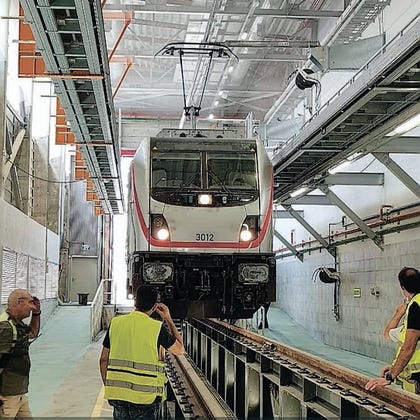
Matav Rails has positioned itself at the forefront of railway engineering and construction through holistic, turnkey project solutions, from concept to European PTO (Permission to Operate) certification. It quickly became a national leader, particularly in electrification of train depots, by partnering with Israeli infrastructure firms and pursuing a clear path toward full professional independence.
"The invasion of October 7, 2023, proved what we always know: Israel must reduce and ultimately eliminate its dependency on foreign railway suppliers," says Avi Zalman. "We can build and assemble railway cars and even locomotives in Israel. The challenges are real, but we have the engineering talent, knowhow and experience. It's time to lay the foundations for a self-sufficient Israeli railway industry to drive innovation across research, academia and manufacturing."
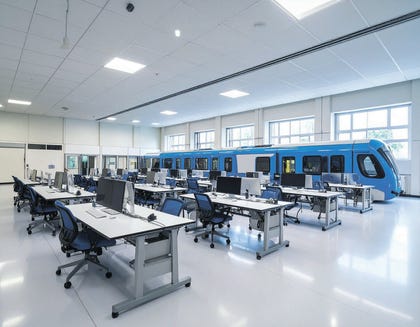
Matav Rails supports this vision by leveraging innovation and advanced autonomous tools while adhering to strict environmental and safety regulations — among them noise reduction and electromagnetic emission limits. The company is also improving rider experience and system resilience through predictive maintenance and smart diagnostics. Its forward-looking initiatives include integrating rail systems into Israel's national drone network and implementing onboard sensor systems to detect maintenance failures in real time via temperature, sound and vibration data.
"Modern trains will essentially 'talk' as they move," says Zalman. "They'll continuously report their technical status and pinpoint exact failure locations along the track. This is a major leap forward in continuity, safety and passenger confidence — and ultimately in the choice of train over car."
Future Developments: Sustainability and Sensor-Based Insights
Matav Rails has recently identified a Dutch-made product that will greatly improve track cleanliness and electrification system maintenance, especially in overgrown areas, continues Ziv. "Instead of sending human inspectors, sensors on locomotives will constantly monitor conditions. With advanced video analytics, we can generate 3D images of any issue or damage in real-time, enabling immediate response. This is an example of how Matav Rails approaches railway infrastructure as a fully integrated system. We're the only company in Israel with this level of comprehensive expertise, aligned with European standards, and we plan to bring it into academia very soon."
Training the Next Generation of Railway Experts
As well as advancing industrial capabilities, Matav Rails is committed to strengthening Israel's human capital in railway expertise technology, particularly in the south of the country. It is currently developing two parallel initiatives:
- A manufacturing facility in Yeruham to produce locally made rail components, and serve as a cornerstone of southern Israel's rail industry.
- A specialized academic training center for theoretical and practical railway training, with plans to partner local institutions, such as the ORT school network.
The absence of formal certification for rail workers in Israel is a critical lack, says Zalman. "In Europe, most railway professionals require licensing. Israel must develop a similar framework — a dedicated vocational school akin to Europe's NATAR, offering structured training, inclusive educational programs and certification to professionalize the entire workforce."
Integrated Operations and Workforce Management
While academic institutions have yet to be created, Matav Rails is addressing immediate workforce needs today through Matav Placement, a staffing division focused on highly skilled railway professionals. Together with that and Matav Surveying, Matav Rails presents a unified organization delivering end-to-end railway solutions.
"Alongside our involvement in national projects and system-wide expertise, from locomotives to rolling stock to tracks, we've built an optimal, multidisciplinary mix of knowledge and skills," explains Ziv. "This enables us to support our clients from planning through implementation all the way to long-term maintenance. Among our key advantages is our size. We're mid-sized, agile and highly accessible, which allows us to avoid bureaucracy and offer on-site services wherever needed. Our deep understanding of the Israeli market, plus our RAMS testing capabilities and PTO certifications, enable us to meet all environmental and accessibility standards."
What Next for Matav Rails?
Israel Railways currently spans some 1,400 kilometers of track and stations, plus two light rail lines in Tel Aviv and Jerusalem. "In the next decade, we expect these numbers to triple to nearly 4,000 kilometers across the national network, light rail lines in Gush Dan, Haifa, Jerusalem and potentially Beersheba, as well as the Tel Aviv Metro," says Ziv. "This massive expansion highlights the impossibility of dependence on foreign suppliers. That's where Matav Rails comes in. We have the expertise and homegrown capabilities to build an autonomous domestic railway industry, cut that dependency, meet Israel's future needs and build a resilient, self-sufficient national rail sector."
With the expected growth and the initiatives it is leading, Matav Rails plans to expand to some 150 engineers, managers, developers, procurement professionals and others. With his background in railway engineering in the UK and the team's continuous professional development, Ziv foresees a future in which skilled local talent, trained in Israel and abroad, will lead the industry. "As the company leading this vision across multiple fronts, we're committed to remaining an integral part of Israel's railway ecosystem," he says.
In collaboration with Matav Rails