After weeks cowering in a cold, dark basement under a relentless barrage of Russian rockets, Olga and her 16-year-old daughter fled Ukraine for Moldova. Dianna, 33, escaped the merciless bombardment of Odessa with her two young sons, protecting them with her body when their bus was shelled as they approached the border. Aleksandra, 24, left home with her young brother when the curfew was briefly lifted, drove until their car came under fire, and walked the last two hours out of Ukraine, hefting their suitcase while her brother carried their terrified cat.
It is thanks to the Jewish Federations of North America system that Olga, Dianna, Aleksandra and some half a million more Ukrainian and Russian Jews have been rescued, sheltered, clothed, fed, healed, counseled and helped into a new future during the first year of Russia’s onslaught on Ukraine.
The infrastructure was ready
The Jewish Federations of North Ame-rica’s CEO and president, Eric D. Fingerhut, explains that the organization is a major player in today’s Jewish world, touching more lives than any other Jewish organization anywhere. “The global network of Jewish humanitarian relief, carefully constructed and meticulously maintained by the pooled resources of the JFNA’s 146 member Federations, is unparalleled in the history of the Jewish people — and probably in that of any other faith or ethnic group,” he asserts.
The Federations system has been uniquely effective during a conflict which is Europe’s most dangerous and bloody since World War II, notes Fingerhut, because the infrastructure was already in place. “The Jewish Federations were positioned to respond immediately to the Ukrainian crisis because we are prepared for emergencies,” he notes. “We don’t start building the fire department when the house goes up in flames. In partnership with other Jewish humanitarian relief networks, we have a sophisticated response in place to contain harm to Jews, who are so often targeted in European wars.”

When the Russians invaded Ukraine on February 24, 2022, “some assets were already on the ground, and others could be immediately deployed,” he points out. “We could tell every member of every North American Jewish Federation from the first day of the Russian offensive: ‘You’re already helping! You’re already saving lives with your ongoing support.’”
Many Jewish Federation members, however, wanted to give more than their annual contribution — both to Ukraine’s 200,000 Jews and to those in neighboring Russia, threatened by economic sanctions and military conscription. Jewish Federations opened a collection into which $85 million in emergency aid poured during the war’s first year. Allocated to 85 NGOs on the ground — principally to JFNA’s core partners, the Jewish Agency for Israel and the American Jewish Joint Distribution Committee — it has contributed to temporary housing for Jewish refugees, safe passage from Ukraine (Dianna and her sons were on one of these special buses), security, humanitarian support, trauma and medical relief, as well as aliyah and integration into Israel.
The scale of the operation is enormous. Eighteen transit centers run by 450 volunteers were set up near Ukraine’s borders in Poland, Romania, Hungary and Moldova. By December 2022, they had given emergency shelter to hundreds of thousands of people, along with 700,000 meals, 354 tons of clothing and toiletries, and medical care to 130,000 patients. Two are still functioning. Some 455 bus and security relief convoys drove 13,742 Ukrainian Jews along often dangerous routes out of the country. A 24-hour hotline has fielded 156,224 calls from Ukrainian and Russian Jews. And close to 100 skilled Russian-speaking Jewish professionals have been recruited through the JFNA Professional Volunteer Initiative to work with refugees in countries neighboring Ukraine.
Enabling and facilitating aliyah
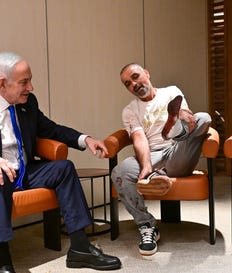
Jewish Federations’ longstanding infrastructure investment is also supporting the largest aliyah to Israel in 30 years — 65,000 people, and counting. Fingerhut went to Warsaw within days of the outbreak of the war, saw the rapid processing of passports and visas, and flew to Israel on one of the first organized immigrant flights. “My fellow passengers were people who, a week earlier, had been living in their own homes and had never expected to leave them,” he says.
With men of fighting age staying behind to fight for their country, a majority of the newcomers to Israel are women, children, the elderly and people with disabilities. “In the long term, like every other aliyah, they’ll contribute their energy and talents to the Jewish State,” says Fingerhut. “At the moment, they need help and support. And that’s what they get from the State of Israel, with significant Federation funding among contributions from Jews worldwide.”
Israel has handled mass immigrations before, and its aliyah machine is well oiled, largely because of the Jewish Agency’s good work (Federations are the Agency’s largest unrestricted funder). New arrivals are lodged for a month in one of 40 hotels across the country, where they receive help finding housing and work, and in enrolling their children in school. By the end of her month in a hotel, Dianna had ID cards and health insurance for herself and her children; she had opened a bank account and was learning her way around Jerusalem. She was then allocated a furnished apartment in an outlying neighborhood, provided with all necessary amenities, rental assistance — and a washing machine donated by a complete stranger. “It’s beginning to feel like home,” she says. “The children are settling down. And I’ll soon be ready to get back to my passion: community theater and performance.”
Those unready to cope after their initial month move on to absorption centers. Aleksandra and her brother (and cat) went to a center in Karmiel. “This is where we really began feeling we could make a life for ourselves in Israel,” she says. “My brother is in school and I’m studying in Kadima, a full-time year-long program that helps young adults bridge social and cultural gaps, and successfully integrate into Israel’s mainstream — and I love it! Our new life in Israel is beginning.”
Aleksandra’s brother began his encounter with Israel in an overnight summer camp shortly after they reached Israel, one among 4,500 newly arrived Ukrainian and Russian youngsters whom this program helped to adjust and heal.
Olga has in-laws in Israel, who also escaped the war, and they live together in a Beersheba apartment, waiting for the war to end and her husband and son to join them. Four months on, she reports that she and her daughter are both in high spirits and have fallen in love with the country. “We’ve made friends and our lives are falling into place,” she says. “Your organization is helping us a lot. We’ve been very lucky.”
Another key to transitioning successfully to life in Israel is employment. Courses in high-level, high-demand professions, such as software engineering, computer numerical control (CNC), culinary arts and hospitality, are among those being offered to the newcomers by the country’s immigration authorities. ITworks, a non-profit whose aim is narrowing employment gaps and promoting diversity in Israel’s high-tech industry, has expanded its boot camps from Israel’s Arab and haredi communities to the incoming Ukrainians and Russians at no cost. Federations’ daily living grants enable them to attend.
Pride in saving lives
Jewish Federations’ help has also found its way to Holocaust survivors driven from Ukraine by the conflict. Through the Foundation for the Welfare of Holocaust Survivors, Federation dollars have helped some 90 survivors, providing both cash and the care of a dedicated social worker.
Federation dollars have also reached traumatized children from Ukraine, funding temporary educational support centers for them in six Israeli cities with large Russian-speaking populations. Housed in community centers and kindergartens, staffed by therapists and educators and run by the nonprofits Yalduta, Early Starters International and Variety Jerusalem, their purpose was to “give every child the right to quality early childhood education, especially in time of war and after experiencing trauma,” says Yalduta and Early Starters cofounder Ran Cohen Harounoff.
The rescue and resettlement operation by Jewish Federations and its partners, which has aided hundreds of thousands of Ukrainian and Russian Jews since February 2022, was successful because the infrastructure was ready and waiting. “It took decades and hundreds of millions of dollars to build,” says Fingerhut. “Our Federation system should feel immense pride in knowing that our investment has saved and continues saving the lives of so many Jews on European soil, and helps rebuild them in Israel. I’m inspired by the many individuals across our system who have responded so generously to the crisis and who continue to make these vital relief efforts possible.”
For more information and to donate to the relief efforts, visit >>
Partnered with Jewish Federations of North America