In the last decades, Netzer sensors, based on breakthrough technologies, have been integrated into countless applications of most developers and manufacturers of security equipment in Israel. The sensors are continually upgraded and integrated as a critical component in ground, mobile, and airborne systems in the fields of security, medical devices, automotive, aviation, and more. The sensors are also embedded in a variety of civilian applications, including advanced measurement equipment, robots, autonomous vehicles, satellites, and space observation systems.

The position sensor market is estimated at an annual volume of approximately 800-1,200 million dollars, with a growth rate of 6.5% per year.
Netzer Precision Position Sensors, founded in 1998, markets and sells its products on the international market. It develops, produces, and supplies advanced absolute rotary encoders, based on unique electric encoder® technology. In addition to the nationally important Merkava project, in which these sensors are integrated, they are also present in applications in Israel and worldwide, in products in the field of medical robotics, industrial automation, communication, and observation satellites.
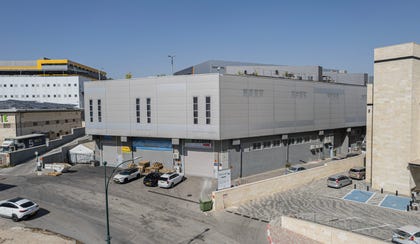
Netzer Precision Position Sensors is located in Misgav, in the Galilee. It employs 45 professionals in a variety of disciplines. About a third are development and engineering personnel; the rest are engaged in marketing and sales, operation and production, and various support functions. "30% of our sales turnover of 20,000 sensors per year is in Israel and 70% worldwide, including the US, European countries, Southeast Asia, Japan, South Korea, Taiwan, Singapore, and India," explains company CEO, Gil Strauss, who has an engineering and management background in a variety of industries. According to him, about 70% of the company’s products are sold for defense applications, with emphasis on observation and tracking systems, and the rest in the areas of health, medical robotics, and more.
You have a part in the Merkava tank project, which is an object of national pride
"It's always gratifying to know that we are part of a project that reflects history and the path taken by Netzer Precision Position Sensors, which is considered an international success. Being part of the Merkava tank and the Namer and Eitan APCs reflects the fact that we are an established company integrated into the local industry and marching forward with creative energy, commitment, and involvement. This is manifested in our relationship with our customers already in the first stages of development, as well as in joint thinking to define the needs and the product, and to find the optimal technological solution for the customer."
What is the main growth platform of the company?
"An ecosystem of complex security devices served as the initial basis for development. Over the years, we have been able to build a platform based on our ability to develop and manufacture our products, and support the customer – all at the same time. The platform supports the integration processes at the customer’s site and the continuation of co-production. Today we offer a variety of off-the-shelf products with a high performance level and support a range of applications. We provide high durability even in extreme conditions of severe vibrations and extreme temperatures, high level of accuracy — all this at low weight and volume compared to competing alternatives. As part of our vision, in addition to the sales phase, we also take part in the initial definition of the product, and assist in installation and in creating the required adaptation for the given application."
In which other industries or systems are your unique sensors found?
"Because the unique technology we developed allows the creation of a rotary position sensor that operates ”contactless, use of the sensor doesn’t create any friction, which makes it possible to be used indefinitely. In practice, the product has the shape of a “bagel,” which allows the transfer of cables, supply lines, and optical fibers through the center of the sensor, and receiving an indication of exact position and angle in thousandths of a degree. The technology also makes it possible to produce applications that are integrated into the final system, in a variety of dimensions and sizes, and at competitive production costs. An example is the integration of the sensors in medical robots used for back surgery, encoders integrated in satellites, measuring devices for the construction industry, and other applications designed for industrial automation, aviation systems, and more."
Israeli success
Netzer Precision Position Sensors began as a small startup in the Galilee, a technological venture that became an established business and a significant player in a competitive world market. The inventor and founder is Yishai Netzer, an engineer with exceptional skills, who in 1998 decided to develop sensors based on a new technology that was then just an idea. The first steps were taken in a technological incubator in the Galilee, where the technology was developed and the first patents were registered. Since then, the company has gone through transformations and growth pangs that have not prevented it from developing and offering standard off-the-shelf products alongside products tailored to customer requirements. Today, Netzer Precision Position Sensors is owned by Ricor Systems and Yzrael Holdings, new owners who, according to Strauss, form a broad and important backbone for its expansion and growth. "This is as much an Israeli success as we would like to see; a company with business activity in Israel, and even more so, in the world." Strauss emphasizes that company products are present wherever there are large and advanced industries, in Israel and everywhere on the face of the earth, in the air, and in space.
Changes in the way of fighting, both on the battlefield and in the rear, which often becomes the front, affect the future of the company, which recently launched a new product line. According to Strauss, it will serve as a growth engine for years to come. "In the future, we will be more accurate, lighter, and competitive, and the sensors we will continue to develop and produce will also be more durable, even in extreme temperatures that are 50% higher than what is currently possible, and in demanding and complex environmental conditions. At the same time, this is a low-cost and efficient production process that will require less manual work and will enable automation of the production," says Strauss, and in the same breath proves that the future is already here: "One of the most important developments are observation and tracking systems included in various types of drones. These are small-weight systems characterized by high performance and low current consumption. Likewise, the next generation of air defense systems and laser interception systems, such as Iron Dome and Light Shield, will benefit from the structure and the high precision capability of the sensors in any environmental conditions. The solutions we provide will also help the civilian industry, whether it is automation systems in the fields of agriculture, such as autonomous tractors and a system for collecting produce, in the automotive industry, for continuous mapping of the environment in which the vehicle operates, in everything related to construction processes, robotic systems for mapping structures, laser scanners, and more."
In collaboration with Netzer Precision Position Sensors