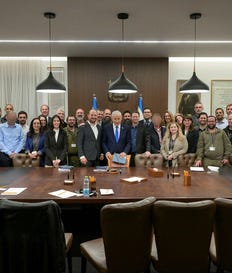
Before going to Stockholm to receive the 2025 Nobel Prize in Physics, Prof. John Martinis stopped off in Israel. Widely regarded as a father of the modern quantum computer, he visited several companies during his visit, met with leading researchers and scientists, and participated in professional conferences. He noted that even a small country like Israel can play an influential role in the global quantum race by combining its strong scientific capabilities, excellent engineering and vibrant entrepreneurial culture. The crucial condition, he emphasized, is building products that outperform those of competitors. Israel has significant potential in this area, he said, praising its rapidly developing quantum ecosystem.
For Qarakal Quantum, Prof. Martinis's remarks are not just complimentary, they outline the company's roadmap. Its connection to Martinis is no coincidence. Company co-founder and CTO Prof. Nadav Katz completed his postdoctoral research under him. The newly crowned Nobel laureate was among the first to demonstrate that quantum phenomena, once believed to exist only in the subatomic realm, can be realized and controlled in large, tangible systems, specifically superconducting circuits. It is this breakthrough that earned him the Nobel Prize and laid the foundation for modern quantum computing.
Today, Prof. Katz and Qarakal Quantum co-founder Dr. Nissan Maskil are applying these principles to create a new generation of quantum computing — one that is more stable, more efficient and designed for real-world industrial applications.

Unprecedented Global Race
The vision of quantum computing emerged in the mid-1980s, but it took almost four decades of technological progress to transform this abstract concept into a practical working tool. It took two decades of development for the first experimental demonstrations, and a further two to bring the technology to a level approaching industrial readiness.
"The great promise of quantum computing lies in its enabling of an entirely new paradigm of computation," explains Prof. Katz. "Because a quantum computer operates under fundamentally different physical laws, it offers dramatic advantages in speed and runtime over classical computers. This is the key to tackling problems that have long been considered unsolvable — among them, real-time optimization of complex systems, advanced materials design, quantum chemistry and code-breaking in cryptography."
Over the years, a growing body of theoretical work demonstrated this potential, but, as Prof. Katz emphasizes, the true challenge is transitioning from drawing board to reality. "There's a vast gap between theory and practice," he says. "The platform we're developing at Qarakal Quantum is based on superconductors, unique electronic circuits that exhibit quantum behavior at extremely low temperatures. Harnessing this behavior for computation is the breakthrough recognized by this year's Nobel Prize in Physics."
More than a theoretical scientific milestone, this is a revolution poised to reshape everyday life. "An unprecedented global race is currently underway to develop stable quantum hardware," he says. "Our goal isn't merely to build the machine itself, but to integrate it with advanced algorithmic capabilities that enable it to address some of humanity's most complex challenges."
Interdisciplinary Connection
Qarakal Quantum was born from a rare combination of deep academic expertise and extensive systems-level experience. Prof. Katz brings decades of research from the Hebrew University of Jerusalem, along with leadership roles in international quantum research communities. He began his scientific career at the
Weizmann Institute of Science, where his doctoral research focused on lasers and cold atoms. Completing a postdoc with Prof. Martinis at the University of California, Santa Barbara, he returned to Israel to pioneer superconducting-based quantum computing. He established the Quantum Circuits Laboratory at the Hebrew University and founded and led the University's Quantum Information Science Center, an interdisciplinary academic community that unites researchers from computer science, physics, chemistry and engineering. Since 2018, he has represented Israel in the European Quantum Community Network (QCN) under the EU's Quantum Flagship program, and currently serves as president of the Israeli Physical Society.
His partner, Qarakal Quantum co-founder and CEO Dr. Maskil, came to quantum computing after a long and distinguished career in Israel's defense industry. He served in the Israel Air Force, acquired a bachelor's, master's and doctorate in physics, turned down a postdoc at Harvard, and joined ELTA Systems, a subsidiary of Israel Aerospace Industries (IAI). Here he founded a group for algorithmic signal- and image-processing and established ELTA's Quantum Technologies Program. Today, he chairs the Israeli Quantum Computing Consortium, an Israel
Innovation Authority initiative which links academia with industry and healthcare organizations. Among its partners are the Hebrew University, the Technion, Bar Ilan University, the Weizmann Institute and the Soroka Medical Center, in line with Innovation Authority belief that such public-private-academic collaboration position Israel at the forefront of the global quantum-computing revolution, scientifically and technologically.
The meeting between the two founders brought a clear realization: to address the demand for practical quantum applications, a fully functional, applied quantum computer must be developed, and the field must move into an industrial paradigm. "Academia excels at generating bold ideas, but a conceptual leap is required to fulfill their promise — the development of real hardware that's close to market," explains Dr. Maskil. He notes that the company collaborates with Israel Aerospace Industries-ELTA and the Hebrew University's technology transfer company Yissum among others.
Qarakal Quantum operates from centers in Tel Aviv and Jerusalem. Experiencing strong growth momentum, it is preparing for a major fundraising round from venture capital investors, aimed at accelerating transition to industrial-scale production. While core development and architecture remain in Israel, chip fabrication is planned at advanced facilities abroad through strategic global partnerships. Some aspects of company innovations are safeguarded by registered patents and some processes and proprietary knowledge are trade secrets, preserving a competitive edge in a market defined by rapid innovation and intense global competition.
A Paradigm that Changes the Rules of the Game
The company employs 22 people, most with PhDs, and has already built its first superconducting-based quantum computer, which has successfully demonstrated initial applications. The goal is to deliver, within two years, a system that provides tangible value to end-users across diverse fields, including transportation and traffic (optimizing air traffic and refining routes in dynamic situations) and logistics (tackling complex problems beyond the capabilities of classical computers).
At the same time, Qarakal Quantum is extending the technology into quantum machine-learning and forging strategic collaborations in genetics and personalized medicine. Supported by the Israel Innovation Authority, these initiatives represent the next generation of medical treatment.
In air traffic management, classical computers perform exceptionally well under routine conditions, "but when situations become chaotic or dynamic, when every second counts and human lives are at stake, they quickly reach their limits," explains Dr. Maskil. "This is where the quantum advantage becomes critical, enabling real-time optimization, shortening routes and preventing significant economic loss."
"We're focused on tackling the most pressing problems facing humanity, global logistical complexity among them," says Prof. Katz. "Existing systems have reached saturation point. They 'choke' under the complexity of these problems and can't generate solutions using classical computing. This explains the intense global race we're witnessing. It's already clear that quantum computing isn't just an incremental improvement but a paradigm shift that fundamentally changes the rules of the game."
A Full Quantum Architecture
Unlike approaches that assemble components from disparate sources, Qarakal Quantum is building a complete, integrated quantum architecture. "Our approach is holistic," explains Prof. Katz. "We design the computer from the ground up, optimizing every layer while matching component performance to end-user requirements. This end-to-end integration under one roof allows us to deliver a system that's far more efficient than typical industry solutions, achieving results an order of magnitude better than other approaches. We're not just building a computer. We're redefining the benchmark for performance."
Dr. Maskil adds, "We prioritize not only the isolated chip, but the entire system. The true test of a quantum computer is its performance. That's why our approach encompasses a closed-loop of design, implementation and rigorous evaluation of every component using precise metrics."
Despite its focus on quantum computing, the company recognizes the importance of integrating with traditional classic systems. Qarakal Quantum has thus developed hybrid algorithms that combine the strengths of quantum and classical computing in a 'ping-pong' approach to data analysis.
The Goal: Global Leadership
As Prof. Martinis noted during his Israel visit, the future of quantum systems depends on specialized expertise in developing sophisticated hardware. He and Qarakal Quantum executives are exploring a range of possibilities for collaboration. "We're not waiting for the future, we're building it now," says Dr. Maskil. "The next generation of our quantum computer is already in advanced planning."
What is the timeline for bringing the quantum computer to market?
"The company's timelines are ambitious, but clearly defined," says Dr. Maskil. "Our first demonstrator is already operational and validates system feasibility. We expect to release the second demonstrator later this year, highlighting design and performance improvements by orders of magnitude. Our strategic goal is to deliver by, 2028, a fully functional quantum system that provides tangible business and scientific value to end-users across a range of industries."
Tell us more about Qarakal's strategic collaborations.
"The company maintains substantial collaborations both in Israel and abroad," responds Dr. Maskil. "As well as working with universities through the Israel Innovation Authority consortium, we participate in international initiatives, such as the EUREKA programs. These partnerships allow us to accelerate development of our capabilities by tapping into the unique expertise of external organizations. We believe that true innovation — and the creation of a quantum computer with significant practical value — can be achieved only through close collaboration with academic and international partners."
In this context, what is the importance of participating in the consortium?
"Beyond its national importance, close collaboration with consortium partners allows us to integrate capabilities across all layers of the computer — from software to hardware — while amplifying the system's overall computational power," explains Dr. Maskil
What of integrating quantum computing with artificial intelligence?
"This is certainly a fascinating direction," notes Prof. Katz. "Ongoing studies in Israel and worldwide demonstrate potential for a deep connection between these fields. It's crucial, however, to be precise. Any integration must fully leverage the unique strengths of each domain and generate meaningful mutual value."
What is your long-term vision as company leaders?
"The field is still in its early stages, though significant breakthroughs toward application and commercialization are emerging," answers Dr. Maskil. "We're only beginning to grasp the full need for quantum computing and the range of applications it can enable. We're at a stage comparable with where AI was three years ago. The quantum revolution is already underway and about to reshape the boundaries of applications across industries. The potential is enormous and largely untapped in a global market projected to reach tens of billions of dollars in the coming decade. Qarakal Quantum aims to deliver an innovative quantum computing architecture, with the goal of developing a practical and competitive product in the coming years. In the long term, the company aspires to be a global leader in the field."
Prof. Katz notes: "While decades ago there was still doubt about whether quantum phenomena could exist in the macroscopic world, today the answer is clear. Globally and in Israel, there's concerted effort to transform these phenomena into the foundation of practical computing, and perhaps even the next scientific revolution. We believe that the right combination of exceptional human talent and pooled resources can drive the development of design capabilities across all layers of computation and measurement, enabling us to achieve a truly unique global breakthrough."
In collaboration with Qarakal Quantum