The Portland Trust develops projects and establishes a chain of Tech centers to encourage entrepreneurship and employment in the periphery, which successfully integrate talent from the socio-geographic periphery into the core of Israeli high-tech. In cooperation with high-tech companies, the Portland Trust projects place many of the talents in jobs originally intended for outsourcing abroad, so that the profit is triple and even quadruple: to the state, to the employers, and naturally, to the local communities and young people themselves.
The projects, run by local leadership, focus on a specific community or segment of the population. For example, projects have been established for religious Druze women, Bedouin women in the Galilee, outstanding computer science graduates from the Arab community who have difficulty integrating into industry owing to various gaps, and a project in cooperation with the Hebrew University of Jerusalem that integrates Haredim into high-tech.
In this way, 260 graduates (70% women) were successfully integrated, most of them in jobs originally designated for development centers abroad. The economic benefit to the state, of those additive jobs is NIS 272 million, until now and NIS 116 million for each additional year.
The organization has expansion plans for current projects and the establishment of additional ones, including a technological "hub" for Bedouin women in Rahat, the integration of Druze men, and the addition of 6,000 high-paying jobs for residents of the south, as part of the rehabilitation plan.
Working in high-tech companies, where teams work intensively together, creates tolerance and equality and dissolves the alienation between communities. In the difficult days since the October 7th disaster, this solidarity has been proven in practice: program graduates and employers have stood together in the face of difficulties, demonstrated unity, and made a significant difference in the various communities. Graduates of the programs participated in volunteer and aid projects and contributed professionally, making an extra effort to fill the places of those serving in the reserves.
Portland Trust sees these achievements as confirmation of a vision that expands high-tech from the center to the periphery and acts as a melting pot that promotes the prosperity of Israeli society, alongside solidarity, equality, and a common striving for achievements. Four NGO's, established in cooperation with The Portland Trust, illustrate the principles and method by which this work contributes to the advancement of populations in the geographic and social periphery.
https://portlandtrust.org.il/
Economic development with social value
Lotus - Women's Hub in High-Tech was established about 4.5 years ago, with the aim of creating an innovative employment solution for outstanding religious and traditional Druze women, training them and integrating them into core positions in high-tech as software developers. The developers work at a technological hub located in Daliyat al-Carmel that allows effective hybrid work, at the same time respecting the tradition that does not support women working outside the community.

This is how Lotus makes a socio-economic and perceptual difference. Lotus was established in partnership with the Portland Trust and has so far integrated about 80 software developers at Amdocs, Finastra, Sapiens, Radcom, and more. Lotus graduates successfully integrated into high-tech and some have advanced to their first management positions.
"Our excellent experience with the Portland Trust programs and the integration of their graduates into the company led us to the decision to expand our R&D activity in the north," says Gilad Shoshani of Finastra.
"The participants of the project are experiencing firsthand the state of emergency in the Iron Sword war," adds Maysa Elsheikh, CEO of Lotus. "80% of the graduates have at least one family member in military service, and many even more. In addition, some of them live along the confrontation line, yet all continue to function successfully and excel in their tasks."
Lotus initiated three fundraising projects with the participation of graduates and many hundreds of volunteers. As part of the "Smile for Heroes" project, over 800 game kits were donated to children in the region surrounding the Gaza Strip and in the north. As part of the "Look Inward" project, over 14,500 relief and pressure release kits were donated to all Druze children aged 5-10, with the support of the Jewish Federation of Chicago. The Maakum project held workshops open to the entire community, where hundreds participated.
This steadfastness in times of severe crisis attests to the contribution of the project to social resilience and the recognition it receives in the community and society, for having great social value, above and beyond its contribution to the economic and personal development of the graduates.
https://www.lotustechhub.com/he"
Technological training and specialized tools
Fursa NGO aims to address the problem of underrepresentation of outstanding Arab engineers who have difficulty finding their first job in high-tech. The organization is aimed at high-achieving Arab computer science graduates who face unique challenges, such as geographic barriers and lack of guidance and role models. "Fursa provides its graduates with a package that includes technological training and dedicated tools that enable them to overcome these challenges," says the organization's CEO, Maya Iron. "Within two years of its establishment, Fursa created a real change for its graduates, with 92% of them accepted in leading technology companies as developers."

Young people from Arab society are particularly motivated to succeed and have high loyalty to the workplace. This motivation is expressed by quick adjustment to the workplace, high productivity achieved in a short time, and very low abandonment rates, as one of the senior development managers at SeeTree (a leading company in the Ag-tech industry) notes: "Fursa graduates are dedicated, diligent, and make a significant contribution both to our unit and to society as a whole. They are valuable members of our team, creating a positive and enjoyable work environment. We were fortunate to work with a diverse and reliable team that always manages to create something from scratch."
The war and the recruitment of many to the reserves have created a new and complex reality. Fursa graduates are active participants in the high-tech companies' contribution to civil society, and they provide stable support for companies during this difficult period.
Fursa, as a mature nonprofit, boosts new nonprofits under Portland Trust and serves as an "older sister" to the Samana NGO. The organization also won a grant from the Innovation Authority to establish a new project for Bedouin women in Rahat, as part of the rehabilitation activities in the south. In this way, Fursa imparts its proven practices, abilities, and experience to the new organization until it reaches independence.
https://www.fursa.org.il"
Quality employment and social involvement
Samana was established in collaboration with Portland Trust in 2022 to promote the integration of talented college-educated women from the Bedouin community in the north into high-tech. Often, cultural and geographic constraints constitute a barrier to integration into high-quality employment outside the village. Samana established a technological "hub" in Zarzir) a Bedouin town in the northern Israel), where employees specialize in software testing and automation development of ERP and CRM systems. The project includes a screening process that examines the candidates' technical, logical, and personal abilities, provides them with vocational and occupational training based on a syllabus determined in cooperation with employers, after which it places them in positions with the employers.
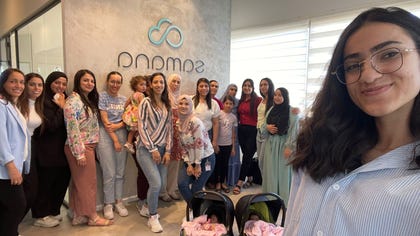
Employees of the first cohort joined SolarEdge in April 2023. The recruitment of the second class was delayed because of the war and is currently underway.
The success of the venture is measured not only by high-quality employment but is also manifest in social involvement. Immediately after the October 7th disaster, with the mobilization of Israeli society, Samana became active within the Bedouin community. "As belonging to a population identified with the state and serving in the security forces, I saw fit for Samana to make a very clear statement to offer every possible help to support the state at this time," says Bushra Mazarib, the CEO of Samana. The women prepared food packages for the South, donated money to buy groceries for the soldiers, collected groceries, and prepared food for the many recruits, transported them to the army bases, and more. "We partnered with every civic initiative in which we could do our part," Bushra emphasizes. "The spread of the Bedouin communities in the north allowed us to reach most places and help."
According to her, the graduates of the project who work from the hub in Zarzir see themselves as an integral part of Israeli society and have a deep identification with their employer. While many employees around them are recruited, they try harder to complete tasks even for employees who are absent for various reasons.
"Whoever wants to be part of the country and enjoy the quality of life in it must contribute its part." This is the spirit of Samana at present.
Professional integration creates social integration
The Beyond Dev program is run by Young Business Leadership (YBL)NGO. The project was launched by Portland Trust two years ago in partnership with YBL, with the understanding that integration into high-quality employment creates social mobility. The program integrates talented young people from Arab society with an academic degree or graduates of computer programs at various colleges, who are retrained in a unique course for automation development positions in high-tech companies. "Gradually, professional integration leads to social integration. Working together creates acquaintance, brotherhood, and mutual responsibility," says Sivan Ella, the CEO of YBL. The program has been a great success. Placement rates are very high and so is employer satisfaction.
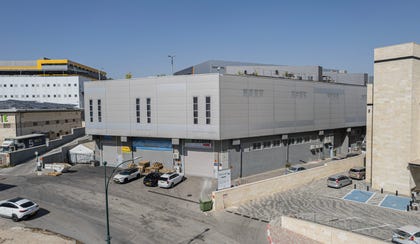
Last June, Pagaya opened a development branch at the NorthMed Innovation Center, established by the Portland Trust in city of Sakhnin, and graduates of the program were the first employees at the site. As far as the Portland Trust is concerned, this is a golden opportunity to integrate talent from Arab society in the north. "The project enabled Pagaya to open a branch in Sakhnin and employ workers from Arab society in various positions," says Yariv Hasar, Pagaya's director of operations in Israel. "We consider cooperation with Arab workers in the high-tech sector, which is the engine of the economy, to be of great importance for Israeli society and economy. We live in a complex period, but I must say that the cooperation continues, and I feel that the employees at the Sakhnin branch feel like an integral part of the company employees, and we are working to make it so. I hope and believe that we will be able to increase the number of employees in this branch and in general, to integrate more employees from the Arab population into the company."
Naturally, there are challenges, and the personal and professional guidance by the program staff for employees and employers comes into play there. Usually, the difficulty leads to growth. Bridging gaps leads to an accelerated process of growth and breaking down of boundaries.
Since the outbreak of the Iron Swords war, the integration has been put to the test and the depth of the connection is evident. Employees feel that they belong and the mutual responsibility becomes tangible. The employees of the project give of themselves compensating for the absence of employees and managers who were recruited to IDF and take on additional projects.
"Breaking down the boundaries of high-tech for talented juniors affects them and their environment," concludes Sivan Ella, "We are partners in building a new ecosystem in Arab society based on the values of excellence, achievement, and technology."
https://www.ybl.org.il/beyond-dev"
https://portlandtrust.org.il/
In collaboration with Portland Trust