THE ORIGINS
The history of Rolex is inextricably linked to the pioneering and visionary spirit of
Hans Wilsdorf, its founder.
Born in Bavaria in 1881, the young man entered the world of Swiss watchmaking in the
early 20th century at a time when the pocket watch was the order of the day. Hans
Wilsdorf began to dream of a watch worn on the wrist. Wristwatches at the time were
not very precise. They were considered to be nothing more than items of jewellery of
particular appeal to women and were produced only in small quantities. Inventive and
curious by nature, Hans Wilsdorf foresaw the immense potential of the wristwatch.
Convinced that it could be at the same time elegant, precise and reliable, he devoted
all his energy to turning his dream into reality.
In 1905, at the age of 24, Hans Wilsdorf founded a company in London specializing in
the distribution of timepieces in Great Britain and in the countries of the British Empire.
To convince the public of the reliability of these resolutely innovative timepieces, he
equipped them with small, very precise movements manufactured by a Swiss
watchmaking company in Bienne. In gold or silver, these watches sparked the interest
of modern sports-minded men and women all over the British Empire.
In 1908 Wilsdorf coined a brand name with which to sign his creations – Rolex. Easy to
pronounce in any European language and short enough to fit on the dial of a watch.
THE QUEST FOR CHRONOMETRIC PRECISION
In order to convince a circumspect public, Hans Wilsdorf first concentrated on the quality
of the movements. Untiringly seeking to improve their reliability, he constantly submitted
them to tests by official quality-control organizations. This relentless quest for chronometric
precision rapidly led to success.
In 1910, a Rolex watch was awarded the first official Swiss certificate granted to a
wristwatch by the Official Watch Rating Centre in Bienne. Four years later, in 1914, the
Kew Observatory in Great Britain awarded the Rolex wristwatch a class A precision
certificate, a distinction which until that point in time had been reserved exclusively
for marine chronometers. From that date forward, the wristwatch was synonymous
with precision.
In 1919, after the First World War Hans Wilsdorf founded Montres Rolex SA in Geneva.
By being closer to Bienne where the movements were manufactured, he gained direct
control of the manufacture of the cases and the finished product.
THE BIRTH OF THE WATERPROOF WATCH
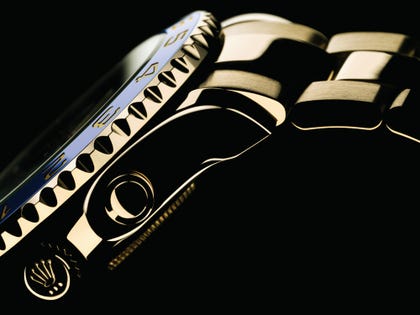
In 1926, a major step was taken with the creation of the first waterproof and dustproof
watch. Named the Oyster, this watch featured a hermetically sealed case which, like
a miniature safe, provided optimal protection for the movement.
The following year the Oyster crossed the English Channel unscathed worn by a young
English swimmer, Mercedes Gleitze, whose support Wilsdorf had enlisted to endorse
his product. This would mark only the first of a long list of testimonials from adventurous
men and women; from achievers whose exploits and daring would, in time, be so
closely associated with the superiority of the Rolex brand. On the occasion of this
landmark event, Wilsdorf published an advertisement on the front page of the Daily Mail
proclaiming the success of the waterproof watch and chronicling the debut of the
Rolex Oyster and its triumphant march worldwide.
THE SELF-WINDING MOVEMENT
The Oyster would soon boast yet another outstanding feature. The year 1931 witnessed
the birth of the Perpetual rotor, a self-winding mechanism, which allowed the watch to
run continuously as every flick of the wrist wound the movement. This system is at the
origin of every modern automatic watch.
In no time the manual-wound watch would become outdated.
For Rolex, the world then became a living laboratory. In oceans, on high mountain tops,
or wherever extreme conditions prevailed around the world, they served to test the
excellence of watches equal to the task. As of the 1930s, the company issued Oyster
Perpetual watches to numerous Himalayan expeditions setting out to conquer Everest.
THE PROFESSIONAL WATCHES
In the early 1950s, thanks to the perfect mastery of chronometric precision and
waterproofness, Rolex developed professional watches that served as tools and
whose functions went far beyond simply telling the time. These watches were intended
for new professional activities, such as deep-sea diving, aviation, mountain climbing and
scientific exploration. Launched in 1953, the Submariner was the first watch guaranteed
waterproof to a depth of 100 metres (330 feet).
These watches generated lasting enthusiasm and asserted themselves as watches of
achievement.
In 1953, equipped with an Oyster Perpetual, the expedition led by Sir John Hunt,
Sir Edmund Hillary and Tensing Norgay was the first to reach the summit of Everest.
In 1960, Jacques Piccards bathyscaphe, Trieste, plunged to a depth of 10,916 metres,
in the Mariana Trench in the Pacific Ocean. An experimental Oyster prototype, the
Deep Sea Special, fastened to its hull, withstood a pressure of over one tonne per
square centimetre.
HIGHLY PRESTIGIOUS WATCHES
As of the 1940s, Rolex also created highly prestigious watches worn by some of the
worlds most influential people. In 1945, Rolex created the Datejust, the first wristwatch
to indicate the date in a window on the dial. In 1956, the Day-Date was introduced.
It was the first wristwatch in the world to show the date and the day of week spelt out
in full.
CONTINUITY THROUGHOUT ITS HISTORY
Only three men have stood at the helm of Rolex since its inception, giving it stability
and consistency. Each of them, in turn, has known how to make bold moves, embrace
progress, and sometimes even break with tradition when necessary to ensure the
success of the company.
In the early 1960s, the expansion of the company required the construction of a new
building in Geneva. This new edifice with its avant-garde architectural design in the form
of two glass towers was inaugurated in 1965.
In 1963, Andrי J. Heiniger succeeded Hans Wilsdorf, who had died in 1960. Andrי Heiniger
had joined Rolex at the age of 28, and devoted his first years with the company to the
development of markets and affiliates abroad. In 1954, Hans Wilsdorf appointed him
Commercial Director in Geneva.
A true commercial strategist, Andrי Heiniger took in hand the destiny of Rolex. With the
benefit of vast experience in the field, he accelerated business development and
reinforced the presence of Rolex worldwide, transforming it into a universal watch brand
and one of the most prestigious watch names in the world.
A man of conviction, Andrי Heiniger had the same sense of anticipation as his
predecessor. In the 1970s, Rolex participated actively in the development of the first
Swiss quartz movement but, to everyones surprise, decided to remain faithful to the
mechanical watch. This decision showed Andrי J. Heiniger to be one of the great
visionaries of contemporary watchmaking and allowed Rolex to save entire segments of
the Swiss watchmaking industry.
Andrי Heiniger was committed to increasing the visibility of the brand. The 1960s and
1970s gave rise to partnerships between Rolex, sports events and exceptional sports
personalities, as well as artists of world renown. These associations contributed to the
emergence of cultural and sports sponsoring in the world of luxury.
In 1976, to celebrate the 50th anniversary of the Oyster, Andrי Heiniger created the
Rolex Awards for Enterprise. These prizes provide financial support to men and women
who seek new ways to increase knowledge of our world and improve the quality of life
on our planet.
These years of expansion resulted in increased recognition and paved the way for the
next chapter in the history of the company.
MOVING INTO THE THIRD MILLENNIUM
In 1992, the Board of Directors appointed Patrick Heiniger Managing Director of the
company.
A lawyer by education and profession, a specialist in international and intellectual
property law, Patrick Heiniger immediately set his sights on strengthening the defence
of the brand worldwide.
Under his impetus in the mid-1990s, Rolex made a fundamental strategic choice and
decided on the vertical integration of its means of production. This initiative was intended
to guarantee control over the manufacture of the essential components of the brands
watches and thus ensure its autonomy. Within this context, Rolex SA, the new corporate
entity of the company since 2002, acquired its historic partner in Bienne, Manufacture
des Montres Rolex SA, in 2004.
The vertical integration programme called for the consolidation of all of Rolexs activities
located in the canton of Geneva at three sites and the construction of new, state-of-theart
production facilities. They became fully operational between 2000 and 2006. Flexible
and multi-purpose in design, they reflect the image of a company in constant evolution,
anticipating and responding to the demands of the market, and thus ensuring the
supremacy of its products.
Now autonomous, with unparalleled production facilities, Rolex enters the 21st century
with reinforced determination. Stronger and more present than ever in the world thanks
to its network of affiliates, after-sales service and watchmaker training centers, it is
resolutely striving to conquer new markets.
In 2002, under the impetus of Patrick Heiniger, Rolex created the Rolex Mentor and
Protיgי Arts Initiative, dedicated to helping promising young artists realize their full
potential under the watchful eye of a renowned mentor in their discipline. This programme
is but one manifestation of the philanthropic tradition of Rolex, which is further exemplified
in the many activities of the Rolex Institute.
In January 2009, Bruno Meier was named General Manager by the Board of Directors,
succeeding Patrick Heiniger as leader of the Group.
For more information please visit our website at:
http://www.euro-asia.co.il/english.aspx