The meaning of the Japanese word "Hotaru" (ホタル) is "firefly" – a little creature that can create flashes of light and thus signal to others like it. It is not for nothing that this name was chosen for the new development by Polaris Solutions, which has been developing innovative and ground-breaking Battlefield Survivability Technologies for 13 years. After developing equipment relating to tactical textiles, power management, camouflage and concealment - the company has also solved the challenge of identifying friendly forces in battle.
This is a particularly painful issue, one that Israel has faced even very recently in the Jenin battles, in which the late Sgt. Major David Yehuda Yitzhak was killed by friendly fire. There have been such cases around the world as well, since the battlefield presents a difficult challenge: identifying who of those present on the ground belong to our forces and who are our enemies, all under the pressure of battle and time. Polaris Solutions has set upon itself the task of assisting the forces in the field and enabling them to make rapid attack and defense decisions, thanks to clear marking of friendly forces: soldiers, drones, robots, platforms and everything else that is on the battlefield.
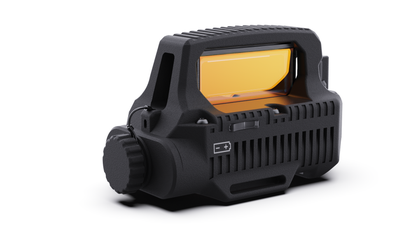
"Today, most of the combat activity is nocturnal, and most forces use various means of night vision, the most common of which are based on starlight amplification technology, which allows vision along the infrared spectrum," says Polaris CEO Asaf Picciotto. "In recent years, there has been more and more use of thermal night vision devices, which are integrated in the telescopic sights of weapons, in long-range observation devices, and in cameras mounted on drones, tanks, airplanes, and helicopters. At night, the entire battlefield looks through thermal eyes. We have developed a technology that makes it possible to mark a thermal wavelength over long distances and with great efficiency. The patented component in 'Hotaru' enables signaling over a long distance, with high energy efficiency and cost effective. This way an army can mark all its forces on the battlefield - from soldiers to drones, and identify them easily."
- How does the technology work?
"The most efficient way to see at night is with the help of sensors, which pick up a range of temperatures and build an image of the surroundings based on this. We have developed a component that is able to radiate to the thermal cameras, and generate a temperature different from the surroundings with a power that allows it to be detected even from a distance of several kilometers. It does this at a low energy cost – just two batteries, and in a size that means it can be installed on a soldier's helmet. This item, called an 'active identification device', sparkles on a thermal wavelength. After it is installed on all the forces in the field, every soldier in the force uses a kind of thermal camera, which carries out image processing with the help of artificial intelligence algorithms. The camera recognizes this unique sparkle and thus signals to the soldier that these are our forces and not the enemy. So, if the soldier looks through the sight of a weapon on which the software component of the camera has been installed - he sees whether the person in front of him carries the active device – meaning that he is from our forces - or not. One side radiates and generates a sparkle and the other side receives the sparkle."
-And the enemy can't also pick up this sparkle? Maybe he also has your system?
"No, because a different frequency can be set for each device, so that it will only receive the sparkle from our forces."
BOX:
Polaris, which was established in 2010 by veterans of the Special Forces Maglan unit, has been working with the Israeli Defense and HLS forces for over a decade and, based on the new technology it developed in Hotaru, has already won an IDF tender for the supply of IFF devices (Identification Friend or Foe) for the ground forces. The company believes that many of its customers in North America and Europe will also be interested in the new product, which is currently being launched. "It's a product intended for the masses," Picciotto says. "It has strong capabilities, while being extremely cost-effective. If until now it has not been possible to put an identification device on every soldier - the price we are proposing will make this possible and thus save many lives."
In collaboration with Polaris Solutions