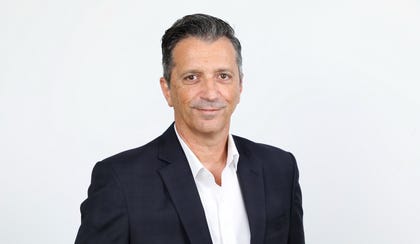
By the time Major General (res.) Doron Almog was appointed Chairman of the Executive of The Jewish Agency for Israel in 2022, he was already highly respected for his impressive career both in the IDF and as a civilian, as well as for his painful yet inspiring personal life story.
Almog explains that two people, both named Eran, guided both his personal and professional journeys. The first Eran was his brother, who bled to death for an entire week when he was left on the battlefield during the Yom Kippur War. "I swore I would never leave anyone behind. Today, as Chairman of The Jewish Agency, this means not leaving any Jew behind," he says.
The second Eran was his beloved late son, who was named after his uncle and was born with severe brain damage. He lived in ADI Negev-Nahalat Eran, the village that his father established in the Negev for adults with special needs, and died 19 years ago at age 23.
"My son is my teacher to this day. Even though he couldn't speak, he taught me what it means to be stigmatized and stereotyped; what it meant to be discriminated against – just like Jews around the world today," he shares. "I came to The Jewish Agency thanks to the two Erans. Every morning, I get up and do everything I can to put the pain behind me and give people hope."
The worst of times, the best of times
For obvious reasons, the last two years have been among the most difficult and challenging for The Jewish Agency. "October 7 was a colossal failure and led to the largest crisis in the Jewish world, but it also brought out the best in the Jewish people in terms of solidarity, volunteerism, huge donations and also Aliyah," Almog points out, adding that since October 7, 2023, more than 50,000 new immigrants arrived in Israel. "This is an Aliyah of brave people who love Israel and decided to come here despite the dangers."
Almog stresses that The Jewish Agency has been working at full throttle on many fronts for the last two years, both in Israel and around the world. "The Jewish Agency is the only organization with a wide global presence positioned to rapidly step in. We are active in 65 countries. We have 3,000 shlichim (emissaries) and are planning to increase their number. In fact, we have boots on the ground throughout the Jewish world – in schools, synagogues, JCCs, college campuses, etc." He is very grateful to work side by side with Mark Wilf, Chairman of The Jewish Agency's Board of Governors. "His work on behalf of the Jewish people is a true inspiration," Almog insists.
Almog views Aliyah as a top priority. "My vision is to bring a mass influx of olim to Israel in the next few years, and especially younger people. I would like to see 40% of them settling in northern Israel and 40% choosing to live in the south. We need to double the population in the Gaza Envelope and the North," he asserts.
The number of Jews showing interest in exploring Aliyah has indeed increased significantly since October 7. The Jewish Agency organizes Aliyah Fairs all over the world, where prospective olim can receive information and answers to all their questions. Mayors of Israeli cities with large immigrant populations regularly attend these Aliyah Fairs to provide details on such subjects as schools, housing, job opportunities and Hebrew ulpans in their city. Almog notes that at a recent Aliyah Fair in France, three times more people attended than in previous years.
The Jewish Agency also operates a Global Aliyah Center – a one-stop Aliyah hotline located in Jerusalem, where representatives are available to counsel potential olim in any of six languages. Almog is proud of the fact that the Center won a prestigious prize for providing excellent service to the public.
"We help olim organize everything in advance of their Aliyah. In addition to helping them find the most suitable community for them to live, we take care of such things as helping doctors receive Israeli medical licenses in advance; and if a family has a disabled child, we make sure they have accessible housing when they arrive; and those are just two examples," he elaborates.

Partnerships of destiny
These days, The Jewish Agency is committed to strengthening both global Jewry and Israel by building and nurturing partnerships between communities in Israel and around the world. "These are partnerships of destiny that give hope," says Almog.
The Jewish Agency's successful decades-old Partnership2Gether (P2G) Global Network – which promotes deep connections and strengthens Jewish communities in Israel and worldwide through meaningful engagement initiatives – has been expanded since October 7. Indeed, Communities2Gether was established in 2024 by The Jewish Agency together with Jewish Federations of North America, Keren Hayesod-UIA and local municipalities, to address the needs of communities which were hardest hit on October 7 through 30 new partnerships.
The bonds created between individuals in Gaza Envelope communities and members of their partner communities abroad strengthen everyone involved. Almog singles out the important relationships that are created among children and youth through another new initiative called Campers2Gether. "During the summer, we send children from Gaza Envelope and northern border communities to camps and other programs with Jewish peers in Europe and North America. Children talk about everything openly. It's truly win-win," he insists, pointing out that these camp experiences help traumatized Israeli children heal and also offer a unique opportunity for kids in the Diaspora to make Israeli friends and hear their stories first-hand.
During last June's war between Iran and Israel, Almog demonstrated how strongly he feels about the importance of person-to-person connections between Israelis and other Jews, especially young people. The day after Operation Rising Lion broke out, 1,700 young Israelis were supposed to fly to the United States to spend the summer as counselors at Jewish summer camps. Since Ben-Gurion Airport was shut down, they had to find a solution so that the Israeli shlichim could reach their destinations on time and wouldn't be replaced by American counselors. "We improvised by sending them through Aqaba in Jordan and then Larnaca in Cyprus. It was crazy, but we were able to bring everyone there on time," he smiles.
Rebuilding Israel
Doron Almog emphasizes the intensive work that The Jewish Agency has been carrying out throughout Israel since October 7. "In the next ten years, we are focusing on rebuilding and strengthening Israel," he affirms. "In the Gaza Envelope region, we are building 1,000 houses in 20 kibbutzim. We want to bring as many olim as possible to that area."

The Jewish Agency's new Ibim Campus exemplifies this spirit. Located near Sderot in the Western Negev, this community offers one-year programs to young olim, including a six-month Hebrew ulpan, access to a wide variety of academic tracks at nearby Sapir College, job placement opportunities, and a pre-Army program for those planning to enlist in the IDF. The first cohort, consisting of 600 young people, which includes a mix of young olim and young Israelis, recently inaugurated the new Campus. "We hope they will want to remain in the region. We will give them incentives to buy homes in the Gaza Envelope," says Almog.
In the past two years, The Jewish Agency has also significantly expanded the scope and depth of its emergency funds, which offer financial support to various target groups in the form of either grants or low-interest loans.
The Fund for the Victims of Terror provides emergency financial aid to individuals and families directly affected by terror, such as people who survived the Hamas attacks of October 7, 2023, or whose homes were hit by missiles, or who were wounded in a terror attack. Within 48 hours of an event, a Jewish Agency representative visits the victims and provides emergency aid of more than $1,000 in cash, letting them know they are not alone. Additionally, through grants and ongoing services totaling up to $6,300, this essential fund covers such costs as psychological counseling, job retraining, and more – to help them recover from the trauma and rebuild their lives.
During Operation Rising Lion last June, as Iran's missile attacks caused large-scale destruction and devastation across the country, The Jewish Agency mobilized a longstanding partnership with JFNA and Keren Hayesod to launch the Rising Lion Fund, designed to provide urgent support exactly where it was needed most. The Fund delivered emergency grants to bereaved families, people injured in the attacks, and those whose homes were destroyed or made uninhabitable.
Almog is also proud that The Jewish Agency provided significant aid to specific towns and cities that suffered direct hits from Iranian missiles. In Bat Yam, where 22 buildings were destroyed, Almog met with the mayor, Tzvika Brot, together with Jewish Agency CEO Yehuda Setton, who was raised in Bat Yam, and Federation leaders from across North America. They presented the city with an emergency grant totaling NIS 10 million. In Beer Sheva, the Soroka Medical Center was damaged by a direct hit and Almog informed Mayor Ruvik Danilovich that his city would receive NIS 6.4 million in emergency aid. The Jewish Agency also provided special funds to the town of Tamra, where four women were killed by an Iranian missile.
In addition, The Jewish Agency has boosted its long-standing Small Business Loan Funds program, which, over the years, has supported small business owners in the Jerusalem, Negev, and Galilee regions, as well as new immigrants, and entrepreneurs from the Arab, Haredi and Ethiopian communities. Immediately after October 7, The Jewish Agency extended emergency loans and grants to help numerous owners of small businesses in the Gaza Envelope and in northern Israel who would not have been able to survive financially without their help.
A new $130 million (NIS 430 million) fund has recently been established by The Jewish Agency together with JFNA to offer reservists subsidized bank loans. Since the outbreak of the war, thousands of Israelis who have been called up for extended military reserve duty have suffered significant harm to their livelihoods, businesses, and family life. The newly established fund will provide families of reservists the opportunity to receive a loan at a subsidized, fixed interest rate. To be eligible for a loan of up to $12,000 (40,000 shekels), reservists must have served more than 200 days since October 7, 2023. The Jewish Agency is also introducing a new Fund aimed at supporting bereaved families.

Giving hope
"The scope of The Jewish Agency's activities is enormous. We are needed more than ever," says Almog. "Only The Jewish Agency is capable of facilitating large-scale Aliyah and at the same time supporting populations in need in Israel. We can provide emergency help very quickly, often faster than the government, and we have played a vital role during the war."
The Jewish Agency's Chairman is determined to remain optimistic about the future. "Absolute victory will be when we build a model society and excel in every field – high-tech, medicine, agriculture, FoodTech, etc. We must be the best in the world," he dreams.
In the meantime, The Jewish Agency will continue to be there to help everyone who needs support. "We are there for everyone. We will not leave the weak behind; we want to give them hope. This includes supporting minority groups such as Israel's Arab and Bedouin populations.
"Our differences are a source of strength. I believe that diversity is a force multiplier, not polarization. We must respect each other and live together. I want to bring people closer together. I am convinced that we can be a democratic, pluralistic, Jewish country which respects everyone," concludes Doron Almog.
For more information, visit > The Jewish Agency for Israel
Click here for the print edition >>
Partnered with The Jewish Agency for Israel