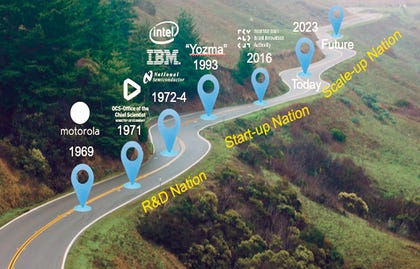
Thirty years on, the fabled Start-Up Nation is more confident than ever and less likely to be seduced by early exits. “In the 1990s, if an Israeli company raised money from a US entity, an American CEO would be brought over to run it,” says Sagi Dagan, whose task as head of strategy for the Israel Innovation Authority is to incentivize technological innovation in start-ups and growth companies. “Today, with that trickle of foreign investment now at $15 billion a year, that would be unthinkable!”
This success story, according to Dagan, is the result of a convergence of national character and wise decision-making through the years. “Israel has innovation in its DNA,” he says. “While the Start-Up Nation traces its economic roots to 1990, socially and culturally they stretch back to the founding of the State. With land area, minerals, water, population and markets all scarce, Israel has long known the economic value of a knowledge-based economy that converts brainpower and technology into products, services and systems. We don’t make cars here, for example, but we lead the world in smart transportation technology. We don’t grow sufficient food, but we lead the world in food technologies.”
Israeli culture is essential in placing its innovation ecosystem among the world’s most successful. It combines a risk-taking, can-do approach with independent thinking, willingness to challenge the status quo and a constant search for better ways of doing things. Its workforce is educated and skilled: Israel has, per capita, the world’s highest percentage of engineers and scientists, and one of the highest ratios of university degrees and academic publications. Its overlapping social circles make a further contribution – family, neighborhood, school, youth movement and military service weave together in a strongly interconnected network, which promotes collaboration and exchange of ideas. “It’s not unheard of for friends to discuss an idea over dinner and start building a prototype the next day,” says Dagan.
Decades of government support
Government decisions over the years have been key in positioning Israel as a global innovation hub. “The government has boosted the tech ecosystem since the early 1970s,” says Dagan. “The Office of the Chief Scientist, a pivotal player in Israel’s tech and innovation ecosystem which evolved into today’s Israel Innovation Authority, emphasized R&D and innovation from the beginning so that, by the early 1990s, industry had become knowledge-based.”

Israel’s restructuring of its economy in the mid-1980s to halt runaway inflation proved another significant decision. “The government opened the market and enabled it to steer its way,” says Dagan. “It ended public sector domination, opened capital markets, let in private investors, and allowed the market itself to identify the most promising entrepreneurs and disruptive technologies. All of this, of course, was central in kick-starting innovative industries.”
Once the government had freed the market, it put in place policies to support it. One was the Technological Incubators Program, set up in 1991 by the Israel Innovation Authority to nurture disruptive, early-stage ideas considered too risky for private investors. Another was the Yozma (‘Initiative’) program, created in 1993, which offered attractive tax incentives to foreign venture capital investment in Israel, along with the promise of doubling private investment with government funds – which not only brought much-needed early-stage funding, but also catalyzed Israel’s venture capital industry. A 2010 OECD report described Yozma as “the most successful and original program in Israel’s relatively long history of innovation policy.”
It was in the early 1990s that Israel experienced the perfect storm, says Dagan. “It had changed to a market economy. It was at peace with Egypt. The USSR had collapsed. The country had taken in over a million Soviet Jewish immigrants, large numbers of them highly trained, and Yozma was providing venture capital funding. Through the 1990s, small start-ups emerged, developed and sold their technology. High-tech became Israel’s main growth engine, the economy boomed, and Israel became known as the Start-Up Nation – the name from the 2009 book by Dan Senor and Saul Singer, “Start-Up Nation: The Story of Israel's Economic Miracle.”
Outpost of Silicon Valley
Today, Israel’s high-tech sector accounts for 18% of the nation’s GDP (25% of its business GDP) and employs 11% of its workforce. Their average age is 41 and increasing numbers of them are women. The sector accounts for one-third of income tax paid in Israel and over half (54%) of the country’s exports. Israel is ranked first in the world in R&D expenditure per capita, investing over 5.5% of its GDP, compared with the OECD's average of 2.7%, the US’s 3.5% and over 4% in South Korea. Venture capital investment has leapt 60-fold, from $58 million in the early 1990s to $15 billion today.
With Israel a powerhouse of pioneering disruptive technologies and high investment return, and a changed global corporate landscape creating new challenges and opportunities, some 400 multinationals have tapped into Israeli innovation. “You would think that you’re in Silicon Valley,” smiles Dagan. “Among the foreign companies with plants and research centers here are Meta/Facebook, Amazon, Microsoft, Motorola, Google, Apple, Berkshire-Hathaway, Intel, HP, Siemens, GE, IBM, Philips, Lucent, AOL, Cisco, Applied Materials, IBM, AWS, J&J, EMC, Toshiba Kodak and Citibank and many more.”
Israel’s high-tech sector has proved resilient, Dagan says. “During the pandemic, much of the global high-tech industry came to a standstill. But here, a rapid government intervention led by the Israel Innovation Authority invested in 300 early-stage companies, which reignited the market and brought back the investors.”
Nor are the widely reported high-tech layoffs cause for alarm, he says. “High-tech, by its nature, is cyclical. It disrupts, creates new business models and reallocates financial and human capital. People move between jobs, and the numbers of those moving in Israel are no higher than in previous years. We still lack some 10,000 skilled engineers, so there are a lot of open jobs.”
Diverse, innovative and flexible
The future of Israel’s high-tech sector remains bright, says Dagan. “Israel is a very diverse innovation hub. It embraces many and varied areas, sells to a swathe of markets and is supported by hundreds of venture capitalists, local and global. Demand continues to rise and R&D centers to expand countrywide. And our size and culture are an advantage in what is becoming an increasingly multidisciplinary world.”
The Israel Innovation Authority emphasizes innovation consortiums that bring together diverse areas of expertise. “There are few places anywhere,” he says, “where you can put, say, an engineer, a programmer, a physician and a marketer in the same room and have them create between them a device to compensate for an insufficient heart.”
Despite the maturing of Israeli high-tech, it remains innovative and flexible, creating new specialties which evolve into new subsectors. One is unmanned aerial vehicles or drones. “Less than a decade ago, drones were the province of the military,” says Dagan. “Today they’re used globally for search and rescue, security and policing – and Israel’s drone technology is cutting edge. Less than a decade ago, food technology was mainly about probiotics. Today, Israel has hundreds of FoodTech companies, many working in highly complex fermentation and cultured meat technologies. In global investment, we’re second only to the US in absolute terms.”
Foodtech, Dagan point out, is among the new technologies that address global challenges. “As a small, innovative and creative nation, we can enter these areas and scale up fast. Climate, energy, transportation and healthcare are some of the technical fields we engage. Solutions to clogged roads and scarcity of public transportation drivers can be solved by autonomous vehicles and AI, for example. Robot technology may be the answer to maintaining standards of care, and even providing care itself for aging populations whose size may overwhelm the number of doctors and nurses.”
“In Israel, our culture is that we will find a way,” Dagan concludes. “We believe in our abilities, we bring investors to back us up, and when we fail it’s a glorious failure. We will do our root-cause-analysis and start again. We combine optimism and chutzpa with limitless vision.”
Partnered with the Israel Innovation Authority