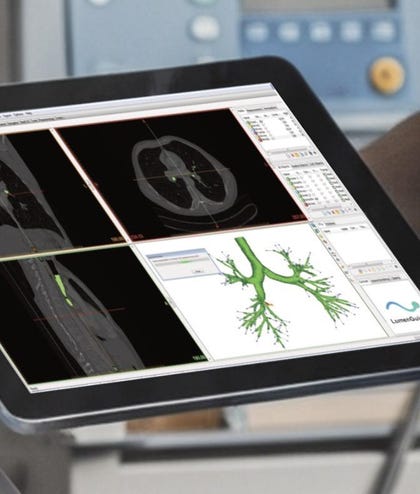
Imagine a GPS that can navigate the most delicate, hidden parts of your lungs. Imagine a system capable of threading through all the branching bronchial passages — the maze of narrow, twisting tubes inside our lungs, invisible to the human eye — and reaching even the deepest point with absolute accuracy. And all this without exposure to radiation, repeated CT scans and unnecessary surgery.
It sounds like science fiction, but for Israeli startup LumenGuides, it is scientific reality. The company's Naviscope system is set to revolutionize how doctors detect lung tumors. It sends a tiny, single-use autonomous robot through the respiratory system, identifying the optimal route to a lesion and enabling precise sampling or treatment.

To grasp its significance, the scale of the challenge must be understood. The start is a seemingly routine CT scan, which reveals a small shadow in the lung — a tiny finding but one which raises critical questions: What is it? Could it be a tumor? Can we even reach it?
In some 40 percent of patients, the answer is no, it cannot be reached. Existing bronchoscopes — thin tubes with a camera at the tip — cannot reach the lung's deep peripheral regions. So instead of a timely biopsy, patients can face repeated imaging, trial-and-error procedures and sometimes even unnecessary surgery.
"I sat with doctors who perform four or five biopsies a day," says Lumenguides CEO Limor S. Prigan-Ben-Asher. "They describe the process almost like a guessing game — sometimes they reach the target, sometimes they don't, all the while exposed to radiation. Neither patients nor medical teams want to live with such uncertainty."
Israeli Surgical Association chair Prof. Doron Kopelman, a , senior surgeon, sums it up bluntly: "As things are now, doctors reply on expensive X-ray systems and inject contrast material every few seconds, sometimes stopping mid-procedure because the patient's kidneys can't handle it. All of this stems from dependence on external sensing tools without which the doctor is effectively blind."
Mapping the lung in motion
Limor Prigan and Yaniv Kirma have known one another since their army days, almost three decades ago. They have kept in touch, speaking over the years about "doing something together." Prigan had gone into global business management in companies like Fujifilm and Ames Aerospace. Kirma is an electrical engineer and physicist with extensive experience in medical devices — he has three successful exits and founded FiberNova, later acquired by Broncus Medical Inc.
With these complementary skills, they envisioned a joint project "one evening in Limor's backyard," recalls Kirma. "We started thinking: there are autonomous cars and drones out there which navigate without human intervention. Why can't doctors do the same inside the human body?"
That evening marked the start of an intensive development process — the merging of engineering and medicine, and building a team to turn vision into reality.
Prof. Kopelman recalls he expected little at their first clinical validation meeting. "I've had dozens of such meetings," he says. "Entrepreneurs come with ideas, and I usually see the barriers immediately. But this time was different."
What made it different?
What made it different, explains Prof. Kopleman, is that "When navigating inside the human body — through blood vessels, airways, bile ducts, all tubular systems — you're guessing whether to go left, right, up or down, because X-ray is two-dimensional while the body is three-dimensional. Kirma proposed use of optical fibers for internal sensing is a real breakthrough. It doesn't rely external tools, magnets, X-rays or magic."
"What we do is turn the airways into a living navigation system," says Kirma. "Our system reads data from optical fibers and translates them into a real-time internal map — as if the lung is drawing itself from the inside."

How Naviscope works
Naviscope has three main components, he explains. One is a robotic arm with micro-motors. The second is an intelligent control unit that processes data in real time. And the third is a disposable bronchoscope equipped with a camera, light source and FBG sensors — optical fibers that measure curvature and position, accurate to the sub-millimeter.
In non-engineering terms, "it's like a mole creating a map of its tunnels — blind but always knowing exactly where it is," he says. "Naviscope doesn't see the lung — it senses it."
Naviscope maps as it moves, using data from the sensors, adds Prigan. "An algorithm builds a dynamic internal map in real time, and calculates the shortest and most accurate path to the lesion. Think of it like Waze suggesting hidden sideroads — but one that's inside the body, finding routes that human doctors can't."
The system can access lesions as small as 1 mm — a dramatic, life-saving improvement over today's standard, where doctors often wait until lesions reach 8 mm because anything smaller is too hard to access. Procedures that now take an hour could soon take minutes.
More impressive still, Naviscope learns. The more it navigates and accumulates data from different patients, the faster, more efficient and more accurate it becomes. "Naviscope isn't simply an upgrade, it's a paradigm shift," says Prigan. "The doctor remains in control, but the robot knows how to get there."
Greater speed, earlier diagnosis
Today, robotic navigation in medicine is dominated by major global companies whose solutions are often complex, expensive and dependent on advanced infrastructure and radiation. Although Israel is a leader in medical innovation, such systems remain out of reach for many institutions due to their high cost.
LumenGuides offers a precise, affordable and fully mobile alternative. While existing robotic systems can cost hundreds of thousands of dollars, Naviscope is priced at around $30,000, making it accessible even to smaller hospitals and clinics.
"Our goal is to make this tool universal — operable anywhere, without the need for dedicated surgical rooms or heavy supporting equipment," says Prigan. "With Naviscope, we're not just innovating, we're making the technology accessible to every doctor.
Rapid progress, even under fire
In the three months since late May from initial investment to the first successful live experiment on September 4, LumenGuides has achieved what usually takes years. And this with war underway, the investment market all but frozen, and budget and employees were modest."We got there with belief, determination and relentless work!" says Prigan.
LumenGuides has raised $2.5 million of a $4 million round, including a $1.5 million grant from the Israel Innovation Authority — a rare vote of confidence for an early-stage company.
The successful test, conducted at Israel's Shamir Medical Center (Assaf Harofeh hospital), demonstrated precise, autonomous navigation without radiation or external guidance. The first human clinical trial is to take place at the Rabin Medical Center (Beilinson Hospital), under the heads of its Institute of Pulmonary Medicine Prof. Mordechai Kramer and Imaging and Vascular Systems Prof. Eli Atar.
Clinical impact
"In medicine, every minute counts," says Prof. Kopelman. "Early diagnosis saves lives. Naviscope will allow doctors to reach places that were once inaccessible more quickly and more safely."
"Our vision is global impact," says Kirma, "not just technologically but also in making precise, safe medicine available wherever it's needed."
A human and economic opportunity
The story of LumenGuides is as much about values as about technology. Its first assembly line is in Kibbutz Nir Am near Israel's Gaza border, which was "a deliberate choice," says Prigan. "Rebuilding in a place that suffered so much is our statement as an Israeli company."
The company has committed to half of its senior management being women, and dedicates its work to the memory of those murdered at the Nova music festival, October 2023, especially Yeftah Tweg. "Yeftah was a brave fighter, and we carry his spirit in what we do," says Prigan.
What is next for LumenGuides? "Navigating lungs is just the beginning," says Kirma. "Our technology can navigate any complex internal pathway, be it in the liver, kidneys, blood vessels, heart or even the brain."
"We're aiming to bring advanced medicine to remote places," says Prigan. "Brazilian villages six hours from the nearest hospital, Siberian outposts, Indian towns with a million residents and no CT machine. Naviscope can reach them in a single suitcase and save lives without infrastructure and without millions of dollars. All it takes is a short training and the will to heal.
"We're looking for partners who understand both the economic and human potential of Naviscope — people who aren't simply interested in investing in technology but in the future of human medicine, people who truly want to change lives," says Prigan.
Naviscope is changing how medicine sees the human body — no longer from the outside, but from within. For the first time, the body itself navigates itself, and technology simply listens.
"True innovation," Prigan concludes, "isn't just a brilliant invention. It's the courage to think differently, to stop forcing a path on the body and start learning from it. This is what we've done, and this is what will change medicine forever."
In collaboration with LumenGuides