Last July, NVIDIA CEO Jensen Huang remarked that if he were to choose a field of study today, he would pick physics over software engineering. The reason, explained the head of the world's largest graphics innovator, is that the next wave of artificial intelligence will be physical — not just intelligent systems that generate texts and images, but robotic systems that operate in the real world, understanding forces like inertia and friction, and integrating with robotics and autonomous vehicles.
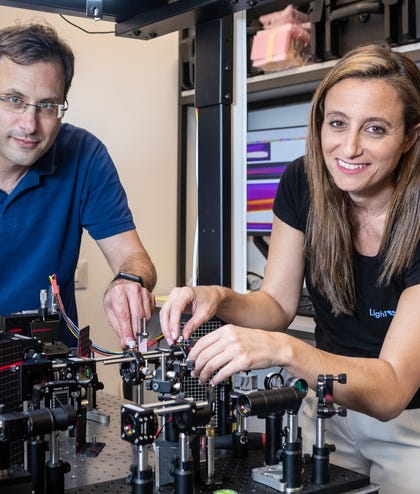
"It was as if he were describing exactly what we're doing," says Dr. Ruti Ben-Shlomi, who, with Dr. Chene Tradonsky, founded LightSolver. "Our optical computer doesn't simply simulate physical laws; it's based on them. That's the foundation of the breakthrough we're bringing to AI."

The computer developed by Ben-Shlomi and Tradonsky uses laser beams to tackle especially complex computational problems that classical and even supercomputers struggle to solve. Its potential applications are vast: from logistics and robotics through drug development and personalized medicine to aerospace, finance and insurance (fraud detection, underwriting) and even smart transportation and autonomous vehicles.
A Global Race for Computing Power
To place this in broader context: the world's tech giants and superpowers, in competition for technological and economic supremacy, are racing to develop powerful computing capabilities.
"They're searching fiercely for new hardware that's stronger, faster, more accurate and more energy-efficient," explains Ben-Shlomi. "Current electronic processors like CPUs and GPUs struggle with problems involving massive parameter spaces or extremely large-scale computations. Running such simulations can take a long time and cost tens or even hundreds of millions of dollars. Their energy consumption carries a huge environmental cost, and there's a strategic side as well: in this race, it's vital for the 'good guys' to have the advantage over the 'bad guys.'"
What of Quantum Computing?
Although quantum computing is often seen to have great promise, Ben-Shlomi urges caution. "Its development faces enormous technical challenges that require vast funding and further scientific and engineering breakthroughs," she says. "More than that, it has inherent physical limits, meaning that practical solutions are likely still to be 10 to 20 years away — and, even then, only for specific problem types. Quantum systems are also massive, costly to operate and maintain, and energy-intensive, which makes betting on this field problematic."
Enter LightSolver
LightSolver offers a completely innovative computer. Its core performs optical computations exclusively through interactions between laser beams. "We've removed all electronic components from the processing stage, thereby eliminating the bottlenecks that characterize other solutions," explains Ben-Shlomi. "Our processing unit has no need for extreme operating conditions, consumes very little energy, and uses primarily passive optical components."
All this reduces dependence on complex supply chains and allows simpler assembly and easier scaling than other systems, making it accessible and attainable for the entire industry, from companies to research centers.
Why does LightSolver call its computer 'Quantum-Inspired'? LightSolver's lasers essentially mimic certain principles attributed to quantum computing. They use the same models — like the Ising — and achieve the same acceleration ratio as most known quantum algorithms. Contrary to quantum computing's exotic and complex methods, however, LightSolver relies on well-established laser and optical technologies.
"In short, we take inspiration from quantum computers but implement it in a stable, simple and practical way that can be applied today," says Ben-Shlomi.
Real-World Applications
"Our processor, the Laser Processing Unit™ (LPU), uses laser interactions to perform complex calculations across diverse fields," she continues, "from cryptography and information security, to rapid drug development via bioinformatics, to more accurate weather forecasting."
It is also useful in materials engineering, as well as in modeling physical phenomena, improving financial models in banking and insurance, and even in creating robots that understand their environment and can calculate physical forces like friction and inertia. In fact, she notes, any complex computational problem with a huge solution space can be solved far faster with LightSolver.
Solving Complex Problems with Up to a Million Variables
LightSolver exists because of a chance meeting between its two founders — Ruti Ben-Shlomi and Chene Tradonsky — in the corridors of the Weizmann Institute of Science, a renowned incubator for groundbreaking inventions.
Dr. Ben-Shlomi, today LightSolver's CEO, began her academic journey with a Master's at Ben-Gurion University in the Negev under the guidance of leading quantum physics researcher Prof. Ron Polman. After a stint as a systems engineer at Intel, she returned to academia, earning a PhD in quantum and atomic physics at the Weizmann Institute in 2019, under leading physicist Prof. Roee Ozeri. Her postgraduate work focused on cold atom and ion systems, today among the most promising quantum computing platforms.
Dr. Tradonsky, LightSolver's CTO, is an electronics engineer by training, and served in the Israel Air Force test squadron at Tel Nof Airbase. After earning his Master's degree at the Technion and a brief period at Nanonics Imaging (a pioneer in atomic force microscopy — AFM), he completed a PhD at Weizmann under Prof. Nir Davidson, researching the use of coupled laser arrays as computational tools.
Ben-Shlomi's expertise in physics complemented Tradonsky's in engineering, leading to the creation of a new type of optical computer — one that uses laser light to solve extremely complex problems much faster than traditional systems. The outcome was LightSolver, a startup whose technology is now being applied to industries ranging from pharmaceuticals and weather prediction to autonomous vehicles and robotics.
Remarkably, LightSolver's computer does not simply simulate physical laws — it operates on them. This gives it a huge advantage in both speed and energy efficiency over classical and quantum computers, offering a practical, scalable and cost-effective alternative for the growing global demand for powerful computing.
From Two Paths to One Vision
"Chene's research demonstrated that an array of lasers can solve a known, challenging problem in computational optics up to a million times faster than a computer," recounts Ben-Shlomi. "While this problem alone was not especially important, Chene consulted me about applying lasers to solve problems similar to those tackled by quantum computers. From this shared interest, we moved forward."
LightSolver was created in 2020 and quickly attracted investors, securing funding from venture capital firms and serial entrepreneurs. "We also received grants from the Israel Innovation Authority and a prestigious €2.5 million award from the European Innovation Council (EIC) to advance our optical supercomputer, together with a commitment for a future €10 million investment," says Ben-Shlomi. "We're especially proud of this as we were among some 60 companies selected from among 1,000 applicants for this unique European accelerator. Today, our Tel Aviv-based company employs 30 people, most with doctorates in physics, mathematics and computer science."

Breaking Performance Limits
LightSolver has demonstrated remarkable achievements. Last June, for example, in collaboration with the High-Performance Computing Center (HLRS) in Stuttgart, Germany, the company showed how optical computing can overcome common bottlenecks in engineering software. And in 2024, it was named a "sample vendor" in the fast-growing new field of photonic computing by the research and advisory firm Gartner.
"High-performance computing (HPC) simulations require massive computational power," explains Ben-Shlomi. "Specialized new processors like our LPU promise to shorten solution times and boost energy efficiency. We're very proud of our collaboration with HLRS, as breaking current performance limits requires close cooperation between industry and research to explore new computational paradigms.
"The LightSolver system uses a coupled laser array paired with unique algorithms tohandle complex problems with up to a million variables, operating 50 to 1,000 times faster than other technologies," she adds. "At the same time, it's relatively compact, operates at high speed, consumes low power, runs at room temperature and looks like a standard rack server."
LightSolver has demonstrated remarkable achievements. For example, last June, in collaboration with the High-Performance Computing Center (HLRS) in Stuttgart, Germany, LightSolver showed how optical computing can overcome common bottlenecks in engineering software. The company was also named a "sample vendor" in the fast-growing new field of photonic computing by the research and advisory firm Gartner.
Toward a Technological Revolution
LightSolver's impact extends beyond theory. Q/C Technologies (NASDAQ: QCLS), a publicly traded American company, has invested significantly to develop LightSolver's optical computer for crypto and blockchain applications — securing exclusive rights in both these fields."LightSolver," they declared, "has pioneered a computing paradigm that outperforms current technologies and offers computing at the speed of light, potentially reducing energy costs by about 90 percent."
Crypto Infrastructure and Sustainable Operation
"The crypto market is maturing, with regulatory progress and institutional adoption," explains Ben-Shlomi. "Yet challenges remain. Energy consumption is soaring, and the quantum computing era brings new threats to network security. We believe the LPU architecture will provide vital building blocks for a post-quantum era, enabling crypto and DeFi to grow sustainably."
Development Status and Partnerships
With the system currently at POC (proof of concept) stage, Ben-Shlomi estimates it will become full-scale within two years. "Following successful pilots with major international players, we're already receiving development contracts and orders," she says.
One example is a leading international airline company seeking an LPU unit tailored to its needs. Another is a strategic partnership with Ansys (recently acquired by Synopsys), integrating LightSolver technology with its engineering simulation software to accelerate design processes. "We've demonstrated that our platform delivers solutions 50 percent faster than existing tools," notes Ben-Shlomi.
The company has also launched the LPU Lab, which enables researchers from academia and industry to access the technology, experiment with optical hardware, and collaborate on new applications.
The Future: Hybrid Computing
Asked whether quantum computing will eventually surpass LightSolver, Ben-Shlomi responds: "We're committed to going all the way! The future of computing will be hybrid: traditional CPUs and GPUs in data centers will be complemented by optical computing solutions like ours, alongside quantum computing for niche, highly demanding tasks. Each technology — classical, optical and quantum — will address the challenges best suited to it, combining unprecedented efficiency."
A Revolution in Computing?
"This is definitely a revolution in computing," she says. "We've shown that our system accelerates physical and engineering simulations and solves complex optimization problems that challenge even the most advanced supercomputers. We believe our technology will be central to next-generation computing, at the forefront of scientific research, and drive breakthroughs in engineering, artificial intelligence, blockchain and more — all while maintaining low energy consumption and high efficiency.
"Our optical computer, which is essentially a physical-analog system, simulates nature in a unique and feasible way," she concludes. "It paves the way for a revolution enabling AI to directly understand and simulate the physical laws governing the world.So yes, we're standing on the brink of a technological revolution that will transform the face of computing."
Joining the Elite group
Further recognition came recently from the World Economic Forum (WEF), which named LightSolver a "Technology Pioneer 2025" — one of the year's 100 breakthrough startups. This designation integrates LightSolver into the Forum's Fourth Industrial Revolution Center, enabling collaboration with global leaders on future technologies.
"We're excited to join an inspiring global community of innovators," said Dr. Ruti Ben-Shlomi. "We believe that advancing computing requires new paradigms — not just faster or more efficient, but also scalable and sustainable. This recognition strengthens our vision and motivates us to push optical computing forward to tackle complex global challenges."
In collaboration with LightSolver