Autism encompasses a world of diversity, representing a broad spectrum where each individual possesses unique abilities alongside distinct challenges and needs. At OTI - the Israeli Autism Association, which works throughout Israel to advance individuals on the autism spectrum, there is a fundamental belief that no single solution fits all variations across this spectrum. This drives OTI to develop personalized treatment approaches tailored to each person's specific situation.
These intervention programs carefully integrate cutting-edge knowledge with individual capabilities and requirements. As part of its comprehensive approach, OTI operates therapeutic centers like "Beit Echad" (One Home) and spearheads innovative projects focused on early diagnosis and professional training—all aimed at enhancing the quality of life for autistic individuals across Israel.
Professor Ofer Golan, who heads the Autism Research Laboratory at Bar-Ilan University, serves on OTI's research committee and founded the "Beit Echad" centers, where he continues to provide professional guidance. According to Professor Golan, their pioneering research aims to deepen understanding of the characteristics and needs of children, adolescents, and adults on the autism spectrum, ultimately developing evidence-based support and treatment programs that make a meaningful difference in their lives.
Tailored Treatment through Targeted Interventions
Professor Golan emphasizes that as knowledge in autism continues to expand and evolve, therapeutic interventions can be increasingly tailored to each individual's unique needs. "There's no universal approach that works for everyone," he explains. "A treatment that benefits one child may not be suitable for another—not just in terms of intensity, but in the fundamental approach itself."
He highlights the critical importance of early diagnosis, noting that research consistently shows earlier interventions can significantly impact brain development. Thanks to advanced diagnostic tools, autism can now be identified as early as a child's second year, with considerable research focused on recognizing signs even earlier. OTI is currently conducting groundbreaking research through an international collaboration with Professor Lonnie Zwaigenbaum from Canada's University of Alberta. This study, led by Dr. Keren Fortuna-Sharon, Dr. Tali Gev, Dr. Irit Mor-Snir, Professor Aviva Bloch, and Professor Ofer Golan, follows infants who have siblings on the autism spectrum, aiming to identify early autism characteristics at ages before formal diagnosis is typically possible.
Addressing Trauma in the Autism Community
Professor Golan also points to their research examining how the October 7 events and the subsequent "Iron Swords" war affected psychological wellbeing among children on the spectrum and their families. The study—conducted by doctoral candidates Shir Shaked-Ashkenazi, Liron Oliver-Aharonson, and Yifat Bar Ben-Shabbat under the guidance of Professor Golan, Professor Danny Horesh, and Professor Sigal Eden—revealed important findings. While children on the spectrum experienced less direct exposure to the October 7 events compared to their neurotypical peers, their mental health was more severely impacted when they were exposed. Golan notes there is a significant gap in research-supported trauma interventions specifically designed for children on the spectrum, and OTI is actively developing and evaluating new therapeutic approaches to address this need.
Key Factors for Effective Autism Treatment
"Successfully supporting individuals on the autism spectrum requires comprehensive professional training in diagnosis and treatment across all age groups, using evidence-based, contemporary approaches," explains Professor Golan. "Continuous evaluation of treatment effectiveness is essential, allowing therapists to refine their goals and methodologies according to each person's unique developmental needs."
"We must equip professionals with sophisticated tools to identify cognitive, physical, and emotional needs while developing therapeutic approaches that enable autistic individuals to flourish in environments tailored to their needs. Equally crucial is fostering collaboration among diverse treatment teams, educational institutions, parents, and the autistic community itself. A truly effective integrative approach demands not just multidisciplinary expertise but genuine partnership with parents, who play a pivotal role in extending therapeutic practices beyond clinical settings into everyday life. One of the primary challenges for children on the spectrum is developing generalization skills—applying abilities learned in therapeutic settings to real-world social environments—and families are instrumental in facilitating this crucial transfer of skills."
Parenting as a Core Element of Therapy
Salma Korabi, an arts therapist and parent instructor at OTI since 2019, shares that although her academic studies gave her a solid theoretical foundation, it is her fieldwork that has given her true understanding of the complexity and diversity of therapy. "My practical work at OTI sharpened my realization that every child brings a world of unique needs, and needs a personalized approach."
OTI's training programs were, she says, critical in her professional development. "As an arts therapist, my focus is emotional expression, creating connections and building positive experiences within the interaction," she explains. "OTI's training taught me that areas such as communication and movement can't be treated separately. I've learned to identify and address sensory regulation difficulties and support children struggling with coordination challenges, sensory sensitivities, or eating difficulties. All impact significantly on therapeutic success and all have helped expand my therapeutic depth and range."
The collaborative multi-professional environment at OTI has given Korabi valuable perspective that enhances her effectiveness.
"Collaborating with speech therapists, for example, helped me understand how to implement alternative communication tools like visual supports and symbols, and guide parents in seamlessly integrating these into their child's daily routines. In addressing feeding challenges, I received specialized training in the SOS (Sequential Oral Sensory) approach for children with selective eating patterns. I've also incorporated the DIR (Developmental, Individual Differences, and Relationship-based) methodology, which leverages children's natural interests as pathways toward therapeutic goals." This openness to integrating diverse approaches allows for truly customized treatment for each family. "The professional development I've received hasn't just expanded my knowledge base—it's fundamentally shifted my perspective on working with children and their families. I've learned to view challenges more holistically and flexibly combine different methodologies based on each family's specific circumstances and needs," Korabi concludes.
Autism Expertise through Minad: Bridging Academic Research and Clinical Practice
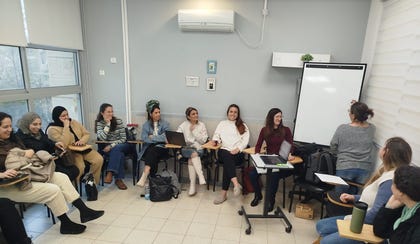
Eti Amiel, an occupational therapist who serves as Director of Learning and Professional Development at OTI, describes "Minad"—the Academy for Training and Specialization in Autism—which provides specialized courses, learning opportunities, and professional resources for therapists, parents, and professionals seeking to deepen their expertise in autism.
"At Minad, we create a dynamic synthesis of cutting-edge academic research and extensive clinical experience," she explains. "We develop innovative educational and training methodologies that integrate evidence-based research, critical analysis of theoretical frameworks, and proven professional practices. While our internal training strengthens OTI's professional team, Minad also extends this valuable knowledge and accumulated experience to therapists and professionals throughout the wider community."
"Our philosophy recognizes autistic individuals as essential contributors to human neurodiversity. We incorporate the lived experiences of autistic people into our educational approach and actively work to include autistic individuals in leadership roles within OTI's professional initiatives."
What are the cornerstones of Minad's learning and training philosophy?
"Learning at OTI occurs across multiple dimensions, including rigorous professional and critical examination of emerging approaches, treatment methodologies, and innovative tools," Amiel explains. "We prioritize preserving the invaluable experiential knowledge of veteran professionals while developing content grounded in theoretical frameworks, critical research analysis, and evidence-based practices—a balanced approach that allows us to responsibly implement innovative, relevant techniques for supporting individuals on the autism spectrum."
"We also emphasize developing specialized knowledge within each professional discipline, enabling team members to deepen their expertise and continuously evolve professionally. Our comprehensive guidance system supports therapists throughout their careers through certified mentors, providing tools for knowledge transfer and offering the highest caliber of professional supervision."
"Furthermore, OTI actively cultivates multidisciplinary dialogue that integrates diverse perspectives, fostering a comprehensive understanding of each child from multiple angles. This approach enhances our ability to provide optimized, personalized support through a holistic lens that incorporates research-based knowledge. Ultimately, we recognize that each child represents an entire universe of potential, and each therapist works to accompany them personally and professionally along their unique developmental journey."
In conclusion, it's essential to remember that multidisciplinary collaboration, continuous learning, and professional guidance form the foundation for effective support of autistic individuals. It is therefore vital that all organizations working in this field implement these principles as core elements of their mission and practice.
In collaboration with OTI