The "Hamas-ISIS" attack on Israel civilians initiated a war that befell us led to an inspiring mobilization of volunteers from all over the country to assist Israeli farmers. Even citizens who had not set foot in a plowed field for years ventured out to harvest in all parts of the land. However, this is not a long-term solution, and farmers will continue to face the challenge of finding reliable and efficient hands, especially during routine times.
Some recognize the need for more advanced solutions for farmers, ones that are not necessarily dependent on humans. The rapid entry of artificial intelligence solutions into the market enables the invention of robotic solutions to aid in agriculture. This is precisely what the startup company VineRobotiqs is doing for vineyard owners – those farmers who cultivate table grapes. Vineyard work is highly complex and involves various tasks throughout the year: pruning, trellising, cluster thinning, cluster shaping, targeted spraying for clusters, and finally, harvesting. These tasks require significant manpower, and the high cost makes it difficult for farmers to sustain.
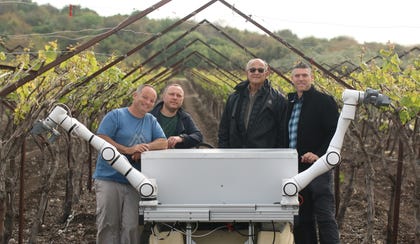
VineRobotiqs has developed an advanced robot based on sensors and artificial intelligence. The robot travels between rows of vines day and night, performing all the vineyard tasks that were traditionally done manually. It identifies different parts of the grapevine and knows how to execute the necessary actions for the growth of high-quality fruit that meets the demanding requirements of consumers, importers, and marketing networks
worldwide.

"Cultivating quality grapes is an art. Grapevines viticulture is intricate while the vine grow rapidly. Therefore, precise timing of actions and the ability to perform them correctly are crucial for obtaining beautiful, sweet, and high-quality clusters," says Royi Levav, CEO of VineRobotiqs. "There is no market for low-grade grapes; therefore, getting the grapes to meet the high-quality standards of the market is a must."
"For these reasons, there is a significant need for a robot that focuses on the quality of the clusters," adds Micha Arnon, the idea's originator and co-founder of VineRobotiqs. "If we invest in and perform the right actions at the right time, throughout the year, with accurate calculations of the workload, we can also increase yield in addition to improving quality."
The challenge for the vineyard goes beyond the availability of human labor; it also involves the training time and the stability of work throughout the day. Unskilled human labor can cause damage to the vineyard, and this damage could affect the next year's yield, resulting in substantial financial losses. The robot's specific expertise in vineyard work allows it to learn deeply and create meaningful value for the vineyard and the industry.
Micha Arnon, born and raised in Kibbutz Sha'ar HaAmakim, immersed himself in mechanics and agriculture from a young age. He was part of the machinery development team in the kibbutz, founded the "Chromagen" factory, and later moved to Kibbutz Ma'abarot, where he established the Ma'abarot Metalworks factory. Due to his connections with vineyards in the Lachish region, he began pondering the idea of a vineyard robot as early as 2014. In 2020, he partnered with Royi Levav, and together they founded the company.
Royi Levav, also raised in an agricultural family in Rishon LeZion, gained knowledge and experience in agriculture. With engineering studies, he worked for years in the hi-tech industry as an engineer, projects manager & R&D manager. Later, Royi established "SensyTIV Technologies," specializing in developing technological solutions for startups. SensyTIV Technologies is the parent company of VineRobotiqs and supports its rapid growth and fundraising efforts.
VineRobotiqs has an entire team of about ten talented entrepreneurs with extensive experience in all the necessary fields to lead a complex product to success. Dr. Nahum Itzkovitz, former director-general of the Ministry of Agriculture, joined the company as chairman of the board, bringing rich experience in managing large systems to aid the company's rapid growth. Dr. Itzkovitz holds a bachelor's and master's degree in agronomy and a doctorate in business administration from the Sorbonne in France. Dr. Uri Dovin, a graduate of the Technion in computer science, specializes in developing algorithms in the fields of machine vision and automatic learning. Agronomist Yaakov Cohen, with extensive experience in training vineyards, provides a deep understanding of all growth processes in the vineyard. VineRobotiqs get great help from Yaron Barkan, an expert on building global grade enterprises while was serving as a manager at AMAT, Rockwell Automation and ADT.
How can grape yield quality be improved in vineyards?
"The grapevine is essentially a manufacturing facility that uses solar energy to convert materials into building clusters and growth," explains Micha Arnon. "The robot's job is to effectively direct the vine's resources to the desired number of clusters. A vine that produces 60 high-quality clusters can also produce 200, but the result will not be of high quality. The robot aims for 80 large and beautiful grains in a cluster, not 150 small and densely packed ones, as density can lead to rot. Therefore, the robot's work focuses on managing and making decisions for vineyard operations based on biological time, with each vineyard task performed in a way that optimizes the vine's resources for achieving the desired fruit quality, adapting to market requirements."
Royi Levav adds, "The complexity of the robot and its high intelligence arise precisely from the need to deal with a growing plant that changes rapidly, with high variability within the plant and among plants, and, of course, with changes in environmental conditions throughout the day and night and changes in weather conditions. Therefore, performing agricultural processes at the right time and in the right quantity is a highly complex task. The farmer must trust the robot and expect a system that preserves the vine and the yield, allowing operations to be performed with confidence. Precise execution and meeting goals in relation to the plant's biological timing has a significant impact."
Micha Arnon concludes: "We need to reduce the toil in agriculture. We are still farming as in biblical times; agricultural robotics is developing rapidly and will be a key factor in the future of agricultural processing. The world's population growth and the shortage in agricultural land requires increasing yield, a need that the robot addresses. There is a need to adopt innovation. There is no room for inefficiency anymore.
"The vision for the future? Our vision is to completely transform the field of food-grade grape cultivation and create a better reality for farmers worldwide. We believe that our technology is a true breakthrough that will not only significantly improve the field of table grapes but also usher in a new era of smart and sustainable agriculture. VineRobotiqs will become a leading international company in its field."
In collaboration with VineRobotiqs