Successful ventures require the “holy trinity” of attributes: an excellent idea that fulfills a real need, expertise in the relevant field, and the ability to turn that idea into a viable, functioning technology. Sealartec’s innovative robotic cradle for autonomously launching and recovering manned and unmanned surface vehicles (USVs) checks all these boxes.
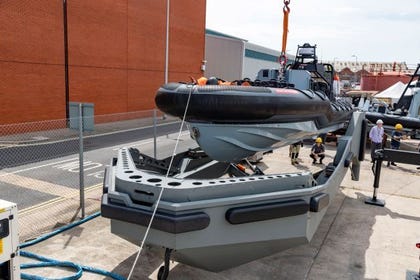
Sealartec’s patented solution works in a similar way as airplanes landing on an aircraft carrier. It entails attaching a small device to the USV, which is guided towards a robotic cradle floating in the water alongside the mother ship. Thanks to sophisticated sensors, the small craft is maneuvered into the cradle’s capture zone – at which point, the cradle’s robotic capture system shoots out and finds the USV’s engagement device. Once secured, the crane on the mother ship’s deck lifts the cradle out of the sea together with the USV. The entire process is autonomous. Just as importantly, the technology can contend with rough conditions such as high waves and low visibility.
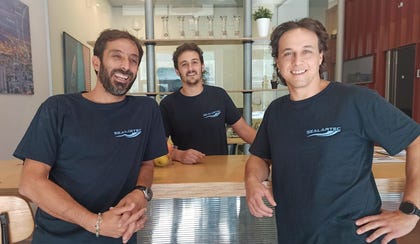
Amitai Peleg, Sealartec’s CEO and Co-founder, has devoted his entire career to USVs. He first encountered the difficulties of launching and recovering small boats when he served as a commander of an elite unit in the Israeli Navy. Already then, he refused to accept that retrieving a small vessel at sea needs to be so challenging, and that it must rely on a trained and skilled crew. “I know how it feels to recover vessels under harsh sea conditions. I understand the dynamic and that is why I was able to invent a technology that actually works,” he asserts.
An enormous challenge
Until now, small vessels could only be attached to the mother ship’s crane if at least three people were on board – one to drive the boat, one to connect the bow to the crane, and a third person to attach the lift line. In addition to being labor intensive, this method is difficult and dangerous, especially when sea conditions are harsh.
About 15 years ago, the development of unmanned surface vehicles kicked off and quickly revolutionized the market, but there was a problem: how could they be used away from shore? As demand for USVs began to grow for both civilian and military applications, the lack of a feasible system for their launch and recovery at sea became a serious impediment.
Although dozens of researchers around the world in both the private and public sectors invested considerable funds in R&D, the development of an effective autonomous launch and recovery system proved to be an enormous challenge. An international EU consortium was even founded for this purpose, but after six years and massive investments, its members presented a solution that performs poorly and is unsuitable when there are high waves. Sealartec is the only company offering a viable, convenient technology.
The first in the world
Peleg has been involved with USVs since they were invented, and it is thanks to these years of experience that Sealartec was able to crack this hard nut. After his Navy service, Peleg studied Mechanical Engineering at the Technion, Israel’s prestigious institute of science and technology, while at the same time working in the USV division at Rafael Advanced Defense Systems. After graduating, he headed the design team that worked on Rafael’s new generation of USVs.
In 2012, Peleg decided to set out on his own as an independent designer and entrepreneur – developing USVs for Elbit Systems, among other projects. His real passion, though, lay in finding a solution for autonomous recovery of USVs. “I had a good idea and realized that the market was getting hotter. I decided to push this project,” he recalls.
In 2018, Peleg and his partner founded Sealartec together with Incubit, Elbit’s technological incubator. By then, they had met with some of the biggest players in the world – all of whom were thoroughly impressed with their initiative – and raised enough money to carry out a sea trial in order to produce a full-scale sea trial demonstration. “In 2020, we were the first ones in the world to carry out a sea state 4 demonstration of an autonomous recovery technology,” Peleg points out, referring to rough conditions with waves reaching up to 2.5 meters.
Shortly thereafter, the startup signed a deal with its first client, BAE Systems, to supply a demonstration unit for the British Navy. “They fell in love with our system and decided to buy one.” Since then, several more contracts have been signed with large companies and government entities, including Israel’s Ministry of Defense and Israel Aerospace Industries. Next month, Peleg will present the technology to a NATO delegation looking to set international regulations. The company recently moved to larger offices and hired additional engineers.
Sealartec is currently raising $5 million in order to fund the next stages of development and meet the high market demand.
In June 2022, Sealartec joined the IN-VENTech startup program, run by Hi-Center and backed by the city of Haifa through the Haifa Economic Corporation. The program has provided valuable support during the startup’s critical development stage, including ongoing professional consulting and financial support. Sealartec is one of 45 Haifa-based startups currently being mentored at IN-VENTech.
“We have an excellent partnership with IN-VENTech. They provide important professional as well as financial support. Their team is eager to help and they are always available to provide good advice and support,” says Peleg.
“I’m passionate about solving problems and I love the sea. I’m happy to have the opportunity to do both,” he concludes with a smile.
For more information about Sealartec, click here.
in partnership with Sealartec