Science and technology on a nanometric scale are at the forefront of today’s research and development, especially in the exact sciences and engineering fields. This discipline encompasses the art and the brilliance that go into artificially creating nanometric structures with atomic precision. Its application pertains to the research of new phenomena and the innovation of advanced machines and systems that cannot be achieved using conventional technologies.
Such activities take place on a daily basis at Tel Aviv University’s Nanotechnology Center, which is one of the largest and most veteran research centers in its field, nationwide. The Center was established in 2000 - years before Israel’s national nanotechnology initiative was launched – and it presently serves as a consortium for the broad research performed by roughly 120 nano-researchers and their teams, hailing from four of the campus’ faculties: Engineering, Exact Sciences, Life Sciences, and Medicine. The Center’s nano-research is multidisciplinary in nature, integrating advanced scientific fields, such as nano-medicine, nano-photonics, biotechnology, quantum physics, nano-mechanics, material science, energy, ecology, nano-sensors etc..
A solution for every customer
“By its very nature, nanoscience and nanotechnology require multidisciplinary efforts, to best leverage sciences, such as physics, chemistry, biology, and medicine while integrating the latest engineering expertise. In essence, all of these traditional disciplines undergo an identity change, when dealing with nanometric systems,” says Alice Polacsi-Segev, the Center’s managing director. “The Center currently oversees one of the country’s largest research enterprises. We have approximately 70 fabrication (production) and characterization ( analysis and imaging) systems, and a team of roughly 20 technology content experts. Namely, our solution is all-inclusive, from the process development stage and its adaptation to the customer’s specific device, through the creation of a prototype using a variety of deposition processes, thermal processes, lithography (photo, electron beam , ion beams, direct writing lasers), etch processes, and metrology (throughout the entire process), to characterization, using advanced approaches that involve electronic microscopes that scan and penetrate, reaching a resolution as great as 10,000,000 times its original size, and maximizing the use of electron ray technologies. This spectroscopy method is sensitive to materials’ surfaces, and is capable of supplying information on their chemical structures, the chemical and electronic states of their various elements, crystallography through X-rays, and more.”

What are the Center’s goals and vision?
“First and foremost, our goal is to enable Tel Aviv University’s researchers to access research and development capabilities and the most advanced technologies possible. Additionally, the Center is committed to advancing Israeli industry via its advanced fabrication and characterization infrastructure. Our infrastructure is accessible to all of Israel’s academic and industrial researchers. Our central location gives us a competitive edge, as does our customer-centric approach and our commitment to deadlines and product quality. Our added value at the Tel Aviv University Nanotechnology Center is the vast knowledge base formed of our researcher community; technological knowledge that can be translated into industrial development.”
The Center is home to two disciplines – fabrication and characterization. What exemplifies the work on each of these disciplines?
“Our production unit, the Chaoul Center for Nanoscale Systems, develops processes and executes fabrication, using infrastructure that empowers end-to-end execution. Namely, from the process development through the device packaging and quality/electrical activity control tests. The production of devices on a nanometric scale isn’t like the production of regular items performed in factory settings. You need a completely different set of machines and technologies that are adapted to the production of nanometric-sized devices. The technologies used by our production unit include various approaches to lithography, such as photo-lithography, electron beam lithography, direct laser writing lithography as well as film deposition processes, etch processes, and metrology to ascertain the devices’ quality.

Our characterization unit, the Wolfson Applied Materials Research Center, specializes in analysis, characterization and high-resolution imaging. The goal is to take a device made from one material or another, and obtain information on it: understand which chemical elements it’s made from, how these elements are linked to one another, what the substance’s molecular and crystalline structures are; all the necessary information on the substance and its behavior. One of the characterization process’ challenge in the nano world relates to creating image using very high-resolution electron microscopes Polacsi-Segev shares the work of Prof. Tal Dvir, who is serving as the Center’s academic director for the past two years, as examples of successful research products produced by the Nanotechnology Center (see side bar). His works focus on the integration of electronic elements in engineered tissues, such as in myocardial tissue. “The idea is to monitor the heart’s activity online using nano-electronics, measure/set the engineered tissue’s activity, and even release medications, with the click of a button,” she explains. “For example, if the tissue signals the presence of an inflammation, anti-inflammatory medications can be released. If the tissue reports a lack of oxygen, bio-factors that activate stem cells to build additional blood vessels can be released. Let’s say that a patient is sitting at home and isn’t feeling well. The doctor receives a message, heads over to their computer, and sees how the heart is faring, leading to an informed – albeit remote - decision on which treatment to administer. This innovative research led to the establishment of a startup, Matricelf.”
Collaborations with the industrial sector
The Center engages in many collaborations with the industrial sector, and the list of companies with which they perform development, prototype production, and attribution processes is long and diverse. Aside from startups such as TriEye, StoreDot, VisIC, DustPhotonics, and Nano Retina, are large, international companies such as Qualcomm, NVIDIA, Tower Semiconductor, and Applied Materials, and security companies such as Elbit, Rafael, and IAI. In recent years, the Center has been flooded with requests for technological solutions for various production processes. For example, a company in the printing industry was in search for a way to produce micrometric-sized ink heads comprised of a matrix of cells, so that each cell would contain colored ink ready for printing. “During the fabrication process, we created such a device. The activation mechanism was thermal, meaning that we built a resistor that heats up and causes the liquid ink to spread within the cell, enabling the ink to exit the printer and make its way to the printing area,” Polacsi-Segev recounts. Another project we executed was for a camera manufacturer that sought to reduce the size, cost, and energy consumption of its cameras. We supplied a solution in the form of three-dimensional electronic equipping via a fabrication process that was customized to meet mass production needs. In this case, we developed a process and built a structure on the camera that enables direct electronic access, thereby eliminating the need for conventional wire-on-wire connections.
“Within the field of cameras, we also provide a solution for the rising need for sensitivity. We do so by adding nanometric layers of special materials. Several startups have requested that we create biosensor prototypes. We’re building them a field effect transistor that is limited by charges to the induced surface area. This is being done by linking molecules that are, essentially, biomolecules – the same biological identification element – which can change the distribution of the semiconductor material’s electrical charge and, as a result, alter its conductivity.”

What’s new in the industrial security field?
“One example is a company from the field that searched for an alternative to the conventional anti reflective coating. These coating materials erode over time, or under extreme conditions. We developed a nanometric-level surface treatment using fabrication processes, to simulate the optic properties of the original coating materials.”
Do you collaborate with entities abroad as well?
“Of course. The Center engages in international collaborations with several institutions around the world, such as Northwestern University in the United States, and Tsinghua University in Beijing. We support student and researchers visits (to our campus, as well as to theirs), and we provide scholarships to PhD and post-doctorate students. We believe that we will be able to expand these collaborations, as soon as the new building is complete.”
Creating wisdom of crowds -& unprecedented technology
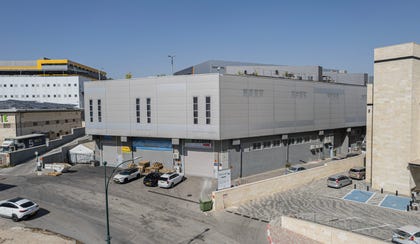
That new building, the Roman Abramovich Nanotechnology Center, slated to open its doors in the summer of 2023, is exciting the Center’s group of researchers, more than anyone else. 7,000 square meters, a clean room that meets the semiconductor industry’s highest standards, and innovative laboratories for the various disciplines within the nanotechnology research community, all equipped with the most advanced tools, are well underway. “The new building will be iconic and will serve as a significant stepping stone. It will be the largest and most advanced research center in the Middle East,” Polacsi-Segev promises. “It will bring together over 100 field experts, and their cumulative knowledge and tremendous potential will translate into new technology developments for existing industries and new startups. Taking all of these brains and expertise and translating them into practical applications in a single location will lead to unprecedented technological wisdom of the crowds being created. The clean room and labs will enable us to realize our wish of launching a dedicated academic program for engineers already working in the industry, so as to equip them with practical skills. This will lead to the actualization of our vision to promote multidisciplinary research activities, oversee and expand the campus’ research infrastructure, support the recruitment of excellent researchers, and further our cross-border research. This will be the new home for the nanotechnology community.”
Standout research products from the Nanoscience & Nanotechnology Center’s researchers

Prof. Tal Dvir, the Department for Molecular Microbiology and Biotechnology, the Faculty for Life Sciences
The integration of electronic elements in engineered tissue such as myocardial tissue. The idea is to monitor the heart’s activity online using nano-electronics, measure/set the engineered tissue’s activity, and even release medications, with the click of a button (for example, if the tissue signals the presence of an inflammation, anti-inflammatory medications can be released. If the tissue reports a lack of oxygen, bio-factors that activate stem cells to build additional blood vessels can be released). All of this happens in real-time, so when a patient is sitting at home and isn’t feeling well, the doctor receives a message, heads over to their computer, and sees how the heart is faring, leading to an informed – albeit remote - decision on which treatment to administer. This innovative research led to the establishment of a startup, Matricelf.
Prof. Adi Arieh, the School of Electrical Engineering
Improving microscopic electronic resolution by correcting lens distortions using a thin membrane (the thickness varies to negate the distortions). A proven 50% improvement in the resolution of a commercial-grade electronic microscope.
Prof. Tal Ellenbogen, the School of Electrical Engineering
Exciting research in the field of AR lens optics. At the Center, multi-layer meta-surfaces are developed and created, with the goal of transforming any pair of glasses into AR glasses.
Dr. Gidon Segev, the School of Electrical Engineering
The development of photovoltaic and photo-electrochemical hybrid cells capable of simultaneously creating solar electricity and breaking down water to create hydrogen (green gas). Surplus energy can be used to break down water and produce electricity, thereby significantly improving the system’s overall efficiency.
Dr. Ines Zucker, the School of Mechanical Engineering; the Environmental Studies track
The development of nanometric-scale materials for the treatment and engineering of more efficient sustainable, and safe to use water sources, as compared to those already in existence today.
In collaboration with the Tel Aviv University Center for Nanotechnology