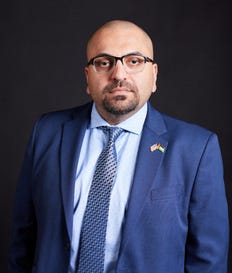
Aviv Shapira, CEO of the company: "XTEND's next-generation systems will enable soldiers to communicate with aerial and ground robots. They will be able to scan a room or patrol an area and communicate with the commander of the operation, just as if they were part of the team."
Why send soldiers, police officers, and rescuers in harm's way when robots can do the dangerous work for them? That's the question that the founders of XTEND asked when they set up the company, in 2018. Not that they came up with a new concept—after all, the idea of a "risking a machine instead of a human" has been the holy grail of robotics for many years, but the people of XTEND had a new perspective on the topic.
"We realized that there are actually two different overarching approaches in robotics development today," recalls Aviv Shapira, one of the four founders of XTEND (alongside his brother, Matteo Shapira, Rubi Liani, and Adir Tubi). "The first is completely autonomous robots and the second is human-operated ones. There are countless examples of ground and aerial robots capable of performing certain tasks, but they are limited in their autonomy. At the same time, there are many examples of robots operated directly by humans, from industrial cranes to photographing or racing drones. This is where the brilliant insight from which our company was born comes in: to combine professional decision-making—both strategic and tactical—involving human intelligence with AI/robotic decision-making in matters of sub tasks. This is actually the idea of combining man and machine into a single operational unit capable of performing complex tasks, overcoming the current limitations of robotic artificial intelligence."
Developing a transparent experience for the user
The background of the founders of XTEND was ideal for the task. The Shapira brothers were the inventors of the first commercial volumetric video (3D hologram) in the world. This format was created in Reply Technologies, the company they founded, which was acquired by Intel in 2016. When the two met Adir Tubi, winner of the Israel Defense Prize, and Rubi Liani, founder of the Israeli Drone Racing League (FRIL), they realized that the concept of the metaverse, as it is called today, could be applied in the real world. "I call our particular technology the realverse," says Aviv Shapira. "It allows in a way 'replicating' human senses—sight, hearing, and the ability to interact—inside remote machines. In XTEND's vision, each of us will be able to enter a remote reality, anywhere in the world and at any given moment, and do whatever comes to mind."
For example?
"From tourism and aviation experiences in space to practical uses such as engineering inspection, construction inspection, and of course, life-threatening tasks. During the development process, our deep insight was that the user doesn't care if he's inside a drone or a robot on the ground. If we can develop an experience that is completely transparent to him, a revolution similar to what we saw in the mobile field will materialize: from the world of Palm Pilot, where the use was in a narrow niche, to that of the iPhone, which actually created the smartphone industry, to this day we all depend on devices for our daily activities."
The needs of the market quickly coincided with the initial XTEND technology. The first step in realizing the company vision was inspired by the racing drone league of their partner Rubi Liani, a group of talented people in their field with years of unique experience. "The pilot took place in 2019 on the Gaza border, where we developed a drone capable of intercepting incendiary balloons and kites with minimal learning needed by the human operator. The soldiers who used the technology were able to 'fly in the air' using the virtual reality glasses intuitively, as if they were actually flying in the air, aiming with their heads, and accurately and successfully intercepting aerial threats."
The XTEND platform quickly evolved into diverse and creative military uses: bomb disposal, remote delivery of battlefield equipment, and actual replacement of soldiers in complex operational environments. Next, the company began working on future generations of its technology to develop the platform so that it offers more than ease of operation in challenging environments. The goal is to reach the more complex world of artificial intelligence, which allows the operator to become a kind of supervisor.
"XTEND's next-generation systems will allow soldiers to collaborate and communicate with aerial and ground robots that are able to perform a large part of the mission independently," Matteo Shapira explains. "They will be able to scan an area or room, patrol an area, and communicate with the commander of the operation just as if they were part of the team."
How does this work actually, technologically speaking, from the user's point of view?
"XTEND turned the technology into an operating system called XOS, an acronym for XTEND Operating System. The system allows users to operate a variety of robotic platforms remotely in a super-simple way. Users can ask the robot to perform subtasks in a smart autonomous way, and the operating system provides revolutionary features such as smart and transparent management of groups of robots and the use of end applications of various companies. This results in a wide range of real-world solutions, from the military ones I mentioned to others that can be useful in the construction industry, such as identifying cracks and leaks."
Who are your customers?
"They are many and varied. They include units in the most advanced military organizations in the world, in Israel and the US. Our products are also used in other markets, in civilian applications, in areas such as engineering supervision and critical infrastructure inspection. The technology is needed mainly in complex environments, such as oil rigs and engineering structures, which require decision-making at a level that a fully autonomous robot cannot yet deliver. Ultimately, XTEND aims for a world where we no longer need to risk life or limb. Remote control with short response times will significantly improve everyone's lives and make them safer."
In association with XTEND