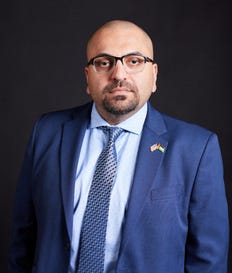
Attorney Gil Rosen, a partner at Joseph Shem Tov & Co., has helped a number of clients who unwittingly violated US government export control laws. "We've managed to resolve the cases, often with the files being closed with a clean slate, but prevention is better than the cure," he says. "With proper planning, such issues need never have arisen."
Rosen recalls instances where Israeli companies sold Israeli made products throughout the world, only to discover after the fact that as the products contained certain US parts and components or technology, that they were also export controlled by US law and they were therefore in violation of thse laws." "This is information that Israeli companies must be aware of and plan appropriately," he says. Joseph Shem Tov & Co. advises defense and homeland security sector manufacturers, brokers, suppliers and other businesses, and frequently find themselves called on to extricate clients from legal predicaments. "Understandably, the security sector is tightly regulated," says Rosen. "It doesn't trade in ordinary consumer products." The Defense Export Control Law, enacted in 2007 and revised in 2017, is the defense sector's regulatory bible, governing exports from Israel of goods and technology classified as military equipment and dual use equipment intended for military use. While it safeguards against unauthorized transfer of products and technologies that could jeopardize national security and citizen safety, it also poses challenges to Israeli companies seeking to compete in international markets.
"Israeli defense companies depend heavily on international sales," explains Rosen. "Their product sales in Israel have limited end-users — the army, the police, the border guards and other such governmental security forces. So they need clients overseas."
Products whose military application is sensitive require export licenses. The law determines which these are and classifies them as either military equipment or for dual-use, i.e. products and technology that have civilian use, but also have sufficiently sensitive military use so as to require a level of control over to whom they are sold. Dual-use equipment sold and exported to civilian end-users must be licensed by Israel's Ministry of Economy & Industry. Exports of all military equipment and exports of dual use equipment to military end-users come under the supervision of the Defense Ministry's Defense Export Control Agency (DECA). Highly sensitive products and technologies are provided with classified status and are subject to further export restrictions.
An Israeli concern whose products for military use and wants to compete globally must register the company, its products and all employees involved in international marketing with DECA, says Rosen. Unlike other countries that have a single export license regime, Israeli military export controls has a tiered licensing system. First, a military exporter must obtain a marketing license from DECA just in order to start marketing their products abroad and once they have achieved a potential sale, they must obtain an export license. This, clarifies Rosen, is to sidestep scenarios where a sale is negotiated with a foreign buyer but denied official, approval, creating the perception that Israeli policy disfavors them.
For example, in the last few yearsDECA simplified its procedures, says Rosen, exempting a need for obtaining the marketing license in many cases, though companies may not use an exemption until they are registered with DECA's exporters registry. Despite efforts to streamline and expedite processes, however, the wait for licensing can still be long, inevitably impacting the competitiveness of Israeli companies. Things grow yet more complex, according to Rosen, when Israeli and American manufacturers collaborate. Regulations governing defense exports from the US are intricate, and Israeli products, made in Israel but incorporating American components or technology, may fall under American export control law as well as Israeli export control law. "I've had clients approach me after coming up against the US government," recounts Rosen. "They hadn't known that cooperation with an American company subjected them to US supervision, and they potentially faced severe penalties, from blacklisting to hefty fines, effectively disrupting a range of transactions for the company." In cases of severe intentional violations, imprisonment is also possible. Contrary to the difficult export process, importing is simpler. Procedures are more straightforward and the list of controlled products is not as extensive as the export control list. For marketing, as we have seen, Israeli companies need a DECA marketing license, unless the product is dual-use and intended for civilian use — but the law does not define what marketing is for the purposes of requiring a marketing license. "In practice, DECA's interpretation of marketing is very broad, so companies may unexpectedly find themselves charged with marketing without a proper license," explains Rosen. "This, like exporting without a license, is considered a criminal offense and incurs severe penalties, from fines to license denials." Exercising caution regarding the lawRosen itemizes further requirements. End-users must be declared to the DECA to secure an export licenses and foreign suppliers also require end-user information in order to facilitate export licensing under their own countries' laws. This, however, can often be commercially sensitive information that many Israeli companies are reluctant to disclose, at least to the foreign suppliers. "No matter," says Rosen. "It's integral to operating in this sector." Another crucial point is manufacturing products in compliance with the regulatory standards of the purchasing country. "If, for instance, you're aiming to sell certain military equipment to the US government, it can't contain certain Chinese components," notes Rosen. "This creates a situation in which a product that can be sold in one country is in violation of the law when sold in another, and must, therefore, be modified." And there is still more to consider. Any product bought by Israel's Defense Ministry with American aid funds must be manufactured in the US. Rosen recalls cases "where companies sold to the IDF as subcontractors to major suppliers like Rafael or Elbit, only to discover that the IDF has decided to start acquiring the end products with the US aid funding and their products must therefore now be made in the US. To achieve that, companies must find US manufacturing partners that will manufacture their products under license, with the bulk of the sales proceeds therefore going to the US manufacturer rather than to them, or they need to set up US subsidiaries to manufacture in the US. Because the associated costs are substantial and the income into Israel reduced, the sales may become economically unfeasible. Not every instance can be profitable enough to justify selling where the IDF is purchasing using US aid." In security transactions, stresses Rosen, where dealings involve governments, the balance of power typically rests with the customer — either the government buyer or the primary local contractor. Negotiations are often much less flexible, requiring wide expertise and industry knowledge to navigate challenges that may not be resolved through concessions from the other party."Do you sense a surge in the security sector?
"I do," says Rosen. "In the sense of a greatly increased workload. The volume of international sales has grown consistently during the past five or six years, even as much as doubling. I remind companies in this sector to remain mindful of the challenges. One that is critical, is not cutting corners to expand business. These are booming times for defense companies, but there are also inherent risks, which often translate into tensions between marketing and sales departments and legal requirements. As business grows, so does the incentive to take shortcuts. Utmost care must be taken to sidestep costly legal blunders. "There's an Israeli tendency to say 'yes' first and figure things out afterward," he continues. "If things can't be worked out, this can be challenging to reverse. And while I've been able to help clients resolve issues with the US and Israeli governments, among others, smoothly and without repercussions, such situations could have been avoided with proper planning. In the security sector, thorough advance planning is the way forward, not crisis management after the event."