In recent days, hundreds of thousands of Israelis have taken to the streets to express their deeply held, but oftentimes conflicting truths regarding the government’s attempts to legislate judicial reforms. While Israel can take pride in its vitality and freedoms, the social divides which prevent civil dialogue from occurring, regarding this and other issues, are sources of serious concern.

“No single truth should exclude all others,” says Ranan Hartman, CEO and founder of Ono Academic College. “Over the years, Israelis have increasingly taught themselves not to hear ‘the other.’ The claim is that there’s no one to talk to, whether the disagreement is over Middle East geopolitics, Israel’s judicial system or anything else. The only way for Israelis to coexist and for Israel to thrive into the future, is for it to be a land of many voices, a society that is truly multicultural.”
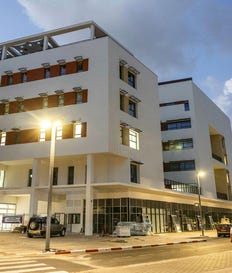
A multicultural society, he continues, needs structures within which different voices can be heard. And this is what Ono Academic College has built. The multicultural ideal it has embraced and nurtured through its 27 years will, this June, find a new home, when its 20,000 students move into Ono’s modern, innovative and purpose-built new campus at the Savyon Junction, Israel’s first entirely new academic campus in decades.
Prompting social change
“The timing couldn’t be better, in light of recent events,” says Hartman. “Our campus will reflect what Israel can and should be. It will be a public arena where all of Israel’s many voices can be heard. Each will tell its own legitimate truth while acknowledging that others hold their own truths.”
Hartman launched Ono College in a caravan with a hundred law and business students 27 years ago. His purpose was to provide access to higher education for marginalized Israelis. In doing so, he has changed the face of higher education in the country. He is now aiming higher, believing that this educational model can prompt social and educational change.
Ono’s original student body has swelled to 20,000 today. They are enrolled in 54 programs of study, all fully accredited by Israel’s Council for Higher Education and all customized to market needs. Today, Ono is Israel’s largest college and half of its students are first generation college students. These include: 4,500 ultra-Orthodox students, 800 students of Ethiopian descent, and 4,000 Arab Israeli students.

In all, over 44,000 students have graduated to date. Among them: the CEO of Cellcom, the CEO of Yes, the CEO of the Bauman Bar advertising agency, the CEO of Paz, social change makers such as the Minister of Immigrant Absorption Pnina Tamano Shata, the first ultra-Orthodox partner in the Y&R firm and many more.
“We’ve been guided from our first day by the belief that higher education is key to national security, economic growth and societal advancement,” says Hartman. “Our multicultural education curriculum places students from every culture and every background onto a level field. Or put another way: we believe that any kid from any neighborhood can get to the top. This is the way for Israel to be strong.”
Over the years, Ono has expanded and now teaches at five satellite campuses, including those in Or Yehuda and Jerusalem which are for Haredi students. On the new campus, which stretches across 37,000 square meters, there will be no more separation. “In Israel, we educate our children in separate schools – religious, secular, Arab – and often live in separate towns,” says Hartman. “This has contributed to the country’s social divisions and today’s insistence on single and exclusive truths.”
A place where everyone feels at home
Located within the Savyon Junction’s new commercial hub close to the light rail station, the newly built Ono Academic College campus connects the existing Kiryat Ono and Or Yehuda campuses with a major metropolitan thoroughfare.
“Our new campus is a single public arena,” he continues. “We’ve built a place where everyone can feel at home, where everyone is equal, where we seek common ground, where no single voice is louder. Student lounges on every floor invite cultures to meet, pedagogy rooms encourage group engagement. Our curricula, both formal and informal, are tooth-combed to ensure against cultural bias. Critical issues, from the campus to the country, are discussed and mediated in a round-table format.”
This core philosophy brings together individuals who in Israel’s routine reality rarely get to interact: left- and right-wingers, settlers, Palestinians, Haredim and members of the LGBTQ community and others. “At the same time, we’re sensitive to private feelings,” he notes. “Our philosophy is ‘to teach each individual according to his or her values,’ with academic facilitators keenly aware of whom they are teaching. And the College’s amenities will be tailored to their needs – such as separate hours for Haredi men and Muslim women at its magnificent sports facilities.”
With the latest technologies, the smartest of smart classrooms and advanced teaching methods, the College will provide a study experience never seen before in Israel, says Hartman. In addition to its sophisticated, state-of-the-art academic buildings, student dormitories, offices and commercial areas, the new campus has several special facilities. One is a simulation center because, as Hartman puts it, “it’s not only pilots and surgeons who need to check how theory works before they practice it. What’s good for them is good for everyone. Meeting reality before you get into it is a crucial stage of learning.”
Modern, well-equipped therapy rooms will serve its occupational, speech, sports and art therapy students – whom Hartman is delighted to see come from throughout Israel’s ethnic mosaic. “This is yet another example of why multiculturalism is so important,” he says. “For a therapist to be effective, he or she must be familiar with the cultural background of their patients and the communities from which they come.”
Uniting sectors and cultures
In this first multicultural campus in Israel, Ono College firmly believes that academia can provide an example of how to live side by side, and will demonstrate how to empower different populations without harming their lifestyles.
“In uniting all sectors and cultures, we’re addressing the challenges faced by the State of Israel for decades to come,” elaborates Hartman. "Today, Ono Academic College is Israel’s largest independent institution of higher learning and we are continuing to grow steadily. Our graduates are in the Knesset, government ministries, local authorities, leading law, accounting and banking firms, in the healthcare system – everywhere. They go out into the world, learning to live side by side with ‘the other.’ They have learned how to make decisions and formulate policies that address and empower diverse populations, without compromising values or beliefs. That is the promise of Ono and truly, that is the only future for us to choose as we come together as a nation.
For more information, visit the website >>
Click here for the print edition >>
Partnered with Ono Academic College