The staff at Yad Vashem has often been asked why the world-renowned Holocaust Remembrance Center in Jerusalem doesn’t display a list of all the Jewish victims of the Nazis. Since most of these victims have no tangible memorial, not even a tombstone, family members often wished there would be a physical place they could visit that commemorates their relatives. The Shoah Wall of Names Memorial in Vienna, Austria, lists the names of 65,000 Austrian Jews murdered during the Holocaust. Other memorials located in various European cities list the names of local Jews murdered there. However, nowhere in the world is there a physical memorial with all the known names of the victims of the Holocaust.
Dr. Alexander Avram, who heads the Hall of Names at Yad Vashem, explains why a wall wouldn’t be feasible: “The Vietnam War Memorial in Washington DC contains approximately 58,000 names. We calculated that a wall with the names of all the victims of the Holocaust would have to be over five kilometers (3 miles) long!”
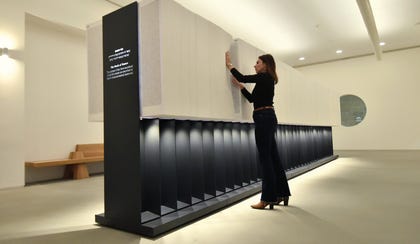
As a result of this appalling fact, the format that was chosen is a huge book containing 17,500 pages including the names, dates of birth and death, and hometowns of the victims. The impressive installation, which is two meters high, eight meters long and one meter deep, is now permanently available to the public in a special hall at Yad Vashem. Visitors can approach the book, turn its large pages, and search for specific names. Since there are still approximately one million Holocaust victims whose personal details haven’t been recovered, there are empty pages at the end of the book that symbolize the names that are still missing.
This new Book of Names was made possible thanks to a generous gift by Marilyn and Barry Rubenstein of New York.
In January, the enormous book was displayed for three weeks in the foyer of the United Nations building in New York City, before traveling to its permanent home in Jerusalem. Brian Rubenstein, son of Marilyn and Barry Rubenstein, remarked at the U.N. that “this Book acknowledges that the six million are not just a statistic. We are people. We are sons and daughters, mothers and fathers. We are artists, scientists and professors. We are human beings. Within its pages we mourn those lives lost. With its inauguration we refuse to become numb to antisemitism, hatred and violence. We refuse to become numbers.”
A memorable inauguration
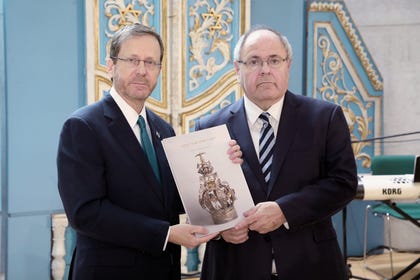
On March 28th, the Book of Names was officially inaugurated at Yad Vashem in an emotional ceremony attended by President of Israel Isaac Herzog and his wife Michal, former Chief Rabbi of Israel and Chairman of the Yad Vashem Council Rabbi Israel Meir Lau, and other dignitaries, along with Holocaust survivors and their families.
Dani Dayan, Chairman of Yad Vashem, said at the ceremony: “The Book of Names is the single largest physical manifestation of remembrance dedicated specifically to the names of the victims of the Holocaust. Its new home on the Mount of Remembrance in the State of Israel, in Jerusalem, the eternal capital of the Jewish people, is especially fitting. The names inscribed in the Book represent the diverse tapestry of the Jewish people – men and women, the elderly and children. They were from cities and towns, from all walks of life, from all levels of religious observance, all connected by their heritage, all part of the Jewish people; together an unfathomable loss. I believe that in the last moments of their lives, they expected to be remembered, and this book is a debt we owe them.”
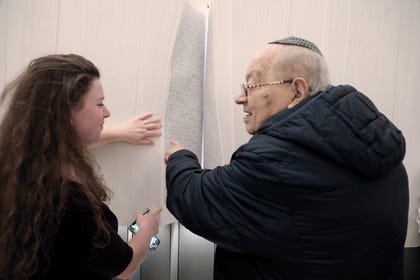
Upon locating the names of many of her family members, Holocaust survivor Bronia Brandman stated: “The fact that there is a Book of Names of so many of these victims ensures that when the last Holocaust survivor dies, our story will remain for humanity to know and remember. The Book will continue to be a testimony to our lives as survivors, as well as to the victims – who lived and breathed, like my parents, siblings, aunts, uncles and cousins did. Each of them had their own unique identity, talents, challenges and dreams. Each one is an entire world, forever lost.”
Holocaust Survivor Rena Quint wept when she found her parents in the Book of Names. She spent much of her childhood in concentration camps – where her entire family was murdered, and she miraculously survived by pretending to be a boy. “This makes me sad because I never knew them. Even though they don’t have a burial place, at least now they are ‘buried’ at Yad Vashem on paper,” she said. After the war, Rena eventually settled in New York and later made Aliyah with her family – which today includes 22 grandchildren and 44 great-grandchildren, many of whom are named David or Sara after her parents. Rena has been volunteering for more than 30 years at Yad Vashem, sharing her tragic survival story with groups from around the world.
Still collecting names after 70 years
Yad Vashem began compiling the names of Holocaust victims in 1954, shortly after it was founded. Since then, every effort has been made to ensure that the Central Database of Shoah Victims' Names is as comprehensive and accurate as possible. To this day, it continues to be a work in progress. “We are constantly working to collect new names. Last year, we added around 50,000 to our database,” Dr. Avram discloses.
Approximately 45% of the names in the database are taken from Pages of Testimony that people have been filling out since the 1950s. Each contains information about individuals who perished as a result of Nazi atrocities. The remaining names (around 55%) come from a range of other sources and are the result of arduous efforts by Yad Vashem’s dedicated staff. Still today, after so many years, a team of 23 experts searches for new information from Jewish communities around the world, concentration camp records, archives, research institutes and anywhere else that may shed new light on the identity of the victims.
An earlier version of the Book of Names was installed in 2013 at the Auschwitz Memorial in Poland. That version contains 4.3 million names, 600,000 fewer than the Book of Names that was just inaugurated in Jerusalem. So many of the visitors to the site of the notorious Nazi death camp have touched its pages that, after just ten years, the wear and tear is evident.
Despite the staggering number of Holocaust victims, each and every one deserves to be remembered for eternity. From now on, there will be a personal and physical memorial that explicitly commemorates the individual men, women and children who lost their lives during the Holocaust. Even after so many years, the Book of Names at Yad Vashem provides important closure for their relatives and descendants. It is also a grim reminder of the scope of the Nazi atrocities for future generations and for all of humanity.
For more information >>
Contact by email >>
Click here for the print edition >>
Partnered with Yad Vashem