Climate change and geopolitical shifts are creating havoc on global agriculture, diminishing vital resources. With a global population expectancy of almost 10 billion people by 2050, the world will need to double its food production, and to do so on 20% less arable land with 50% less water than today. “Sustainability is not a choice. It is a necessity. At Netafim we have been pioneers of sustainability in agriculture for almost 60 years and believe that part of our mission is to continuously bring innovation to this field for Israel and the entire world. We recognize that we all face similar challenges, and the effects of climate change are felt globally.” Said Gaby Miodownik, Executive Vice President and President of Orbia’s Precision Agriculture business (Netafim).
Growing more, with less
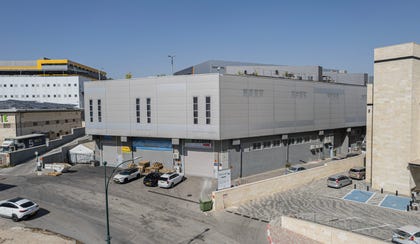
Netafim was started in 1965 in Kibbutz Hatzerim in the Negev desert, by farmers seeking irrigation solutions so that they could grow crops in the dry, desert region. The Kibbutz members had seen the success of the newly implemented drip system, invented and developed by water engineer Simcha Blass. They knew then, much as we know now, that survival is dependent on finding methods that allow plants to survive and thrive amid challenging climate conditions and minimum resources. Little did they know that the system they perfected would revolutionize agriculture globally.
Netafim pioneers in irrigation and fertigation, digital farming, integrating real-time monitoring, analysis and automated control into its state-of-the-art system. "At Netafim we believe that innovation and sustainability are deeply intertwined. With our proficiency in agronomy and technology, we have the ability to create solutions that can bring positive impacts to the agricultural sector, the environment, and the economy as a whole." Says Miodownik.

Netafim’s mission is “to grow more with less” by finding irrigation solutions that are environmentally, economically and socially sustainable, regardless of the crop, climate, soil, or region. This allows farmers to achieve higher yields and better-quality crops, while using less water, fertilizer and energy. The Netafim technology is capable of coping with lower quality water and planning shortage while executing and supervising water delivery and irrigation systems. The result is money saved, and a drastic cutting down on environmental damage. Netafim’s greenhouse solutions, large scale irrigation projects and community irrigation initiatives around the world, bring true change, stability in agriculture and a secured food chain.
The rice revolution
Take rice, for instance. Rice is the most prolific source of sustenance worldwide, accounting for more than one quarter of the caloric intake of people living in developing countries, and a staple for more than half the people around the world. What is less known is the significant impact rice has on the environment, responsible for 10% of global methane emissions and using 30-40% of the world’s annual consumption of fresh water.
Netafim has developed end-to-end irrigation technology, creating a resource efficient alternative to traditional methods, resulting in the use of 70% less water, 30% less fertilizer and 36% less energy, and in elimination of methane emissions. The irrigation system allows for precise application of water and nutrients to the plant, at the right time and place and in small, measured doses, thus providing optimal growing conditions. “If just 10% of paddy rice farmers switch to drip irrigation, the reduction in emissions will be equivalent to taking 40 million cars off the road,” says Miodownik.

The initial financial resources needed to undergo a change from traditional agricultural methods to avant-garde technology, can be hefty, so Netafim created a carbon credit program for drip irrigated rice, allowing companies to compensate for their carbon footprint by paying the farmers to reduce their emissions. Carbon credits serve an important role in financially assisting farmers in adopting sustainable or regenerative agricultural practices that reduce or sequester emissions, with each credit representing one ton of CO2 equivalent emissions. “The potential impact of drip irrigated rice is revolutionary - a game-changer for all of humanity” Miodownik affirms.
Irrigation solutions for every problem
Netafim offers innovative, tailor-made problem-solving irrigation solutions. For example, take the SOPHIA PSS – a climate adaptive irrigation solution for precision crop protection, designed to make orchards growing increasingly sustainable by generating a significant and measurable reduction in environmental and climate impact. It is a fixed-point precision system for the application of phytosanitary treatments and anti-frost protection for tree crops, that allow operating in peri-urban areas and in difficult conditions, such as during rainfall or on steep orchards.
The frost protection feature of the SOPHIA PSS is based on Spray Overcanopy Application. Due to climate change, there are more frost events than in the past, harming plants, often prohibiting fruit growth and ruining crops. Thanks to its technical features, the Spray Overcanopy Application, can be successfully used for defense against frost damage up to a temperature of -5°C and reducing water use by 50% compared to traditional high-flow and full-coverage methods.

Dairy Farmers needed a solution to manage manure waste. At the same time, droughts pushed for solutions to use water more efficiently. Netafim came up with a solution, utilizing dairy wastewater to fertilize feed crops. The SDI-E is a subsurface drip irrigation solution that reduces environmental contamination and allows the consistent and reliable application of dairy effluent as a nutrient-rich fertilizer, while at the same time reducing of CO2 emissions, water consumption, soil compaction and the dispersion of plant protection products in the environment.
Community irrigation solutions
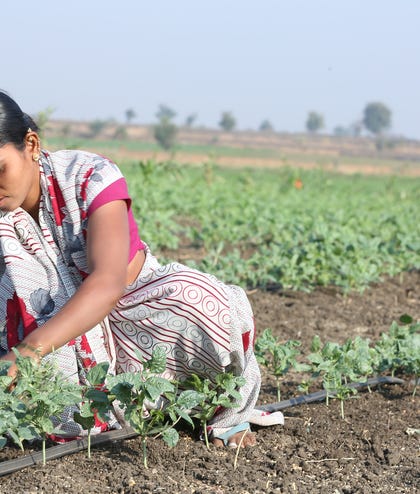
Netafim, together with governments and the private sector, gives growers a whole new level of control over their agriculture future by educating the markets about sustainable agriculture practices and irrigation solutions. The innovative business model of “community Irrigation” changes the socio-economic landscape of rural communities with precision irrigation and brings together small holders, agricultural investors and Netafim’s technology, with the goal of ensuring sustainable and thriving farmer communities. In effect, the environmental impact on the crops is eliminated, allowing for the generating of predictable income for the farmers, and optimizing investor returns. The company also place great emphasis on empowering the women of their communities by introduction of easy-to-use innovative agricultural technologies, such as drip systems, making the need to carry immense amounts of water great distances, redundant and driving maximum yields. These programs amplify women’s power, increasing their economic contributions and offering them newfound independence. The farmers learn that the initial investment is one for decades ahead.
The irrigation projects empower communities by removing practices of underpaid labor while decreasing the use of water, energy and fertilizers with any size farm. The result: making the world a better place to live in through sustainability and agricultural innovation.
Partnered with Netafim