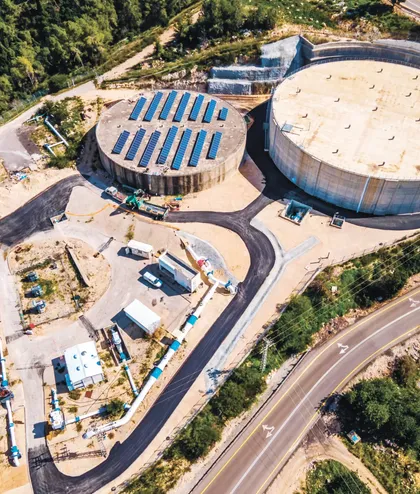
The role of Israel's national water company, Mekorot, cannot be overstated. Established in 1937, its contribution to the country predates Israel’s birth and is inextricably linked with its development and success. Mekorot, however, has never rested on its laurels. Today, as in the past, it is engaged in vast new projects and creating new water frontiers.
Providing water for Jerusalem for the next half-century
One of these is designed to meet Jerusalem’s water demands for the next 50 years. After six concentrated years, it has completed Israel’s longest water tunnel. Extending 14 kilometers from Eshtaol-Kisalon to Ein Kerem, with pumping stations at either end, its pipeline carries into the capital immense quantities of desalinated water from the Mediterranean Sea. The cost of the project: NIS 3 billion.
Mekorot’s director of innovation, Dodi Belser, was “happy to announce the inauguration of this tunnel, Jerusalem’s fifth water system, almost 30 years after its fourth tunnel, during during the administration of the late Prime Minister Yitzhak Rabin, in 1994. At capacity, the new system will provide an annual 450 million cubic meters of water — equivalent to 75 percent of all water annually desalinated in Israel today. Through the enormous pipeline running through the new tunnel (at 108 inches or almost 3 meters, its diameter is taller than the tallest person), it is designed to supply the water needs of Jerusalem, Ramallah and the Bethlehem area until 2060. This project, like many others,” notes Belser, “embraces a belief in water as life-sustaining, and that its provision must be unconditionally guaranteed.”
The unprecedented engineering that enabled this fifth water source for Jerusalem has been nominated for Best Water Project of the Year, and Mekorot has been proposed as the Best Public Water Company in the World by the annual Worlds of Water Conference that meets in Berlin later this year.

Reversing Israel’s National Water Carrier
A second Mekorot flagship project currently underway, with even wider impact, is the National Carrier Flow Reversal Project. Israel completed its National Carrier in 1964 to bring water from the Sea of Galilee in the north to the country’s populated center and its arid south. Today’s groundbreaking undertaking returns water to its natural sources with an emphasis on the Sea of Galilee. “The concept is revolutionary,” says Belser. “It’s the first time it’s ever been done. We’re filling a natural water reservoir with desalinated water from the sea, and will use only the excess — thus solving the problems of insufficient precipitation and dry periods characteristic of our region.”
The idea is to pour water into the Sea of Galilee instead of pumping it out?
“Exactly that,” says Belser. “The Sea of Galilee — Lake Kinneret — is a national treasure, a centerpiece of tourism, agriculture and, especially, geopolitics. Every year, we take from it 100 million cubic meters of water to send to Jordan, and did so even during the drought years of 2013 to 2018. If we’re to increase the water we send our Jordanian neighbors and protect our reservoir, it’s vital to retain the lake’s water level. This was the birth of the idea to pump desalinated water into the Sea of Galilee — up to 120 million cubic meters a year until 2026 at a cost of some NIS 1 billion.”

The project also has significant environmental impact, he continues. One example is the final section of a 2.5-kilometer pipeline, which spills into Nahal Zalmon. “The stream there was drying up,” he says. “We’ve brought it back to life with a significant injection of water.”
Connecting to the National Carrier
Another Mekorot focus is connecting unwatered land to the National Carrier for both agricultural and urban development. A prime area is the Arava, the desert valley that extends 200 kilometers from the Dead Sea to Eilat along Israel’s border with Jordan. Drilling for water here is expected to be complete by 2026. A second focus is Beit Shean and the Beit Shean Valley. “Shockwaves from the massive earthquake in Turkey and Syria last February reached Israel and damaged wells and waterpipes along the Syrian-African Rift, making the water unsafe to drink,” explains Belser. “This was a wake-up call to us to connect the region to the national water system. The project has the added benefit of potentially doubling the amount of water we supply to Jordan — providing up to 200 million cubic meters a year — and to isolated areas in the Galilee Panhandle and the Golan Heights.”
What role does technological innovation play?
“As Israel’s national water company, security is of major concern,” says Belser. “It’s no secret that there are continual and major cyber threats to all infrastructure, including water. We’re constantly alert to the hundreds of thousands of sabotage and intrusion attempts registered by our computers each year, and heavily invest in sophisticated layers of protection to block such threats. In fact, Israel’s National Cyber System for Critical Infrastructures judges our protection on the highest level. We maintain a complete set of solutions from protocols to drills to be ready for any scenario — and even assist other countries.”

Is Israel a global water power?
“Israel, a country with a desert climate, is recognized for recycling about 90 percent of its wastewater for agriculture,” says Belser. “With Singapore, we’re at the forefront of water technology. This makes us internationally attractive. Water technology featured in the Abraham Accords, and is key in our relations with Bahrain, Morocco, Azerbaijan and Jordan. Jordan is one of four Muslim countries to which we provide water, water planning, control or consultation. As a startup nation with special water technology expertise, we and eight young companies have accumulated a great deal of knowledge over the years.”
A smart water world and an international water forum
The status of the Israel’s water industry was emphatically acknowledged at a dedicated UN water conference in New York, where Mekorot CEO Amit Lang announced the company's intent to establish an international water forum. This will address overflow of knowledge to other countries, he said, “so that none are left thirsty.”
How far is technology part of Mekorot’s everyday life?
“The changes of recent decades clearly show the significance of technology to Mekorot,” says Belser. “It once took a week or more for water from the National Carrier to reach the faucets of central Israel. Today, with desalination, that time has been cut to 15 to 30 minutes, with water quality remaining high. This is a genuine revolution, rooted in technological capabilities that range from sensors to IOT devices and big data. The name of today’s game is smart water, artificial intelligence and machine learning. Together, they have transitioned the economy of process technology focused on chemicals to a new, more technological world, which optimizes water systems as never before.”
What challenges are ahead?
“Climate change is one of the biggest,” says Belser. “Perhaps bigger still is that, by 2060, there’ll be some 25 million people living here between Jordan and the Mediterranean Sea. All of them will need water. This presents a very grave challenge, demanding creative and long-term thinking together with serious investment in technology.

“We’ve submitted to the Israel government our plan for 2050, examining existing gaps and needs. Our reliance on desalinated water will undoubtedly increase, and we must also invest in the infrastructure to cope with extreme events, from earthquake to cyberattack. And all this while we connect all parts of the country to the National Carrier.”
Partnered with Mekorot